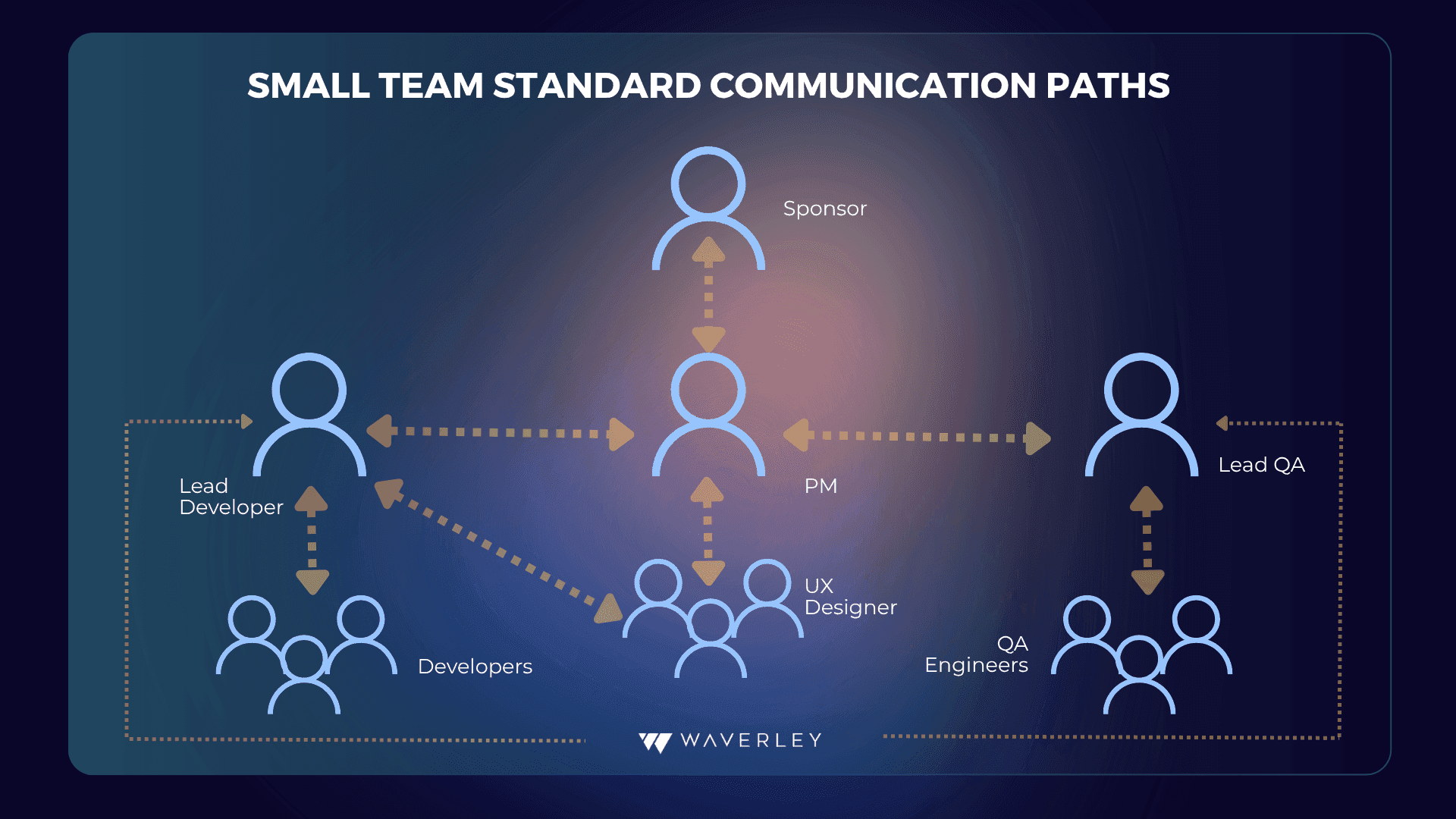
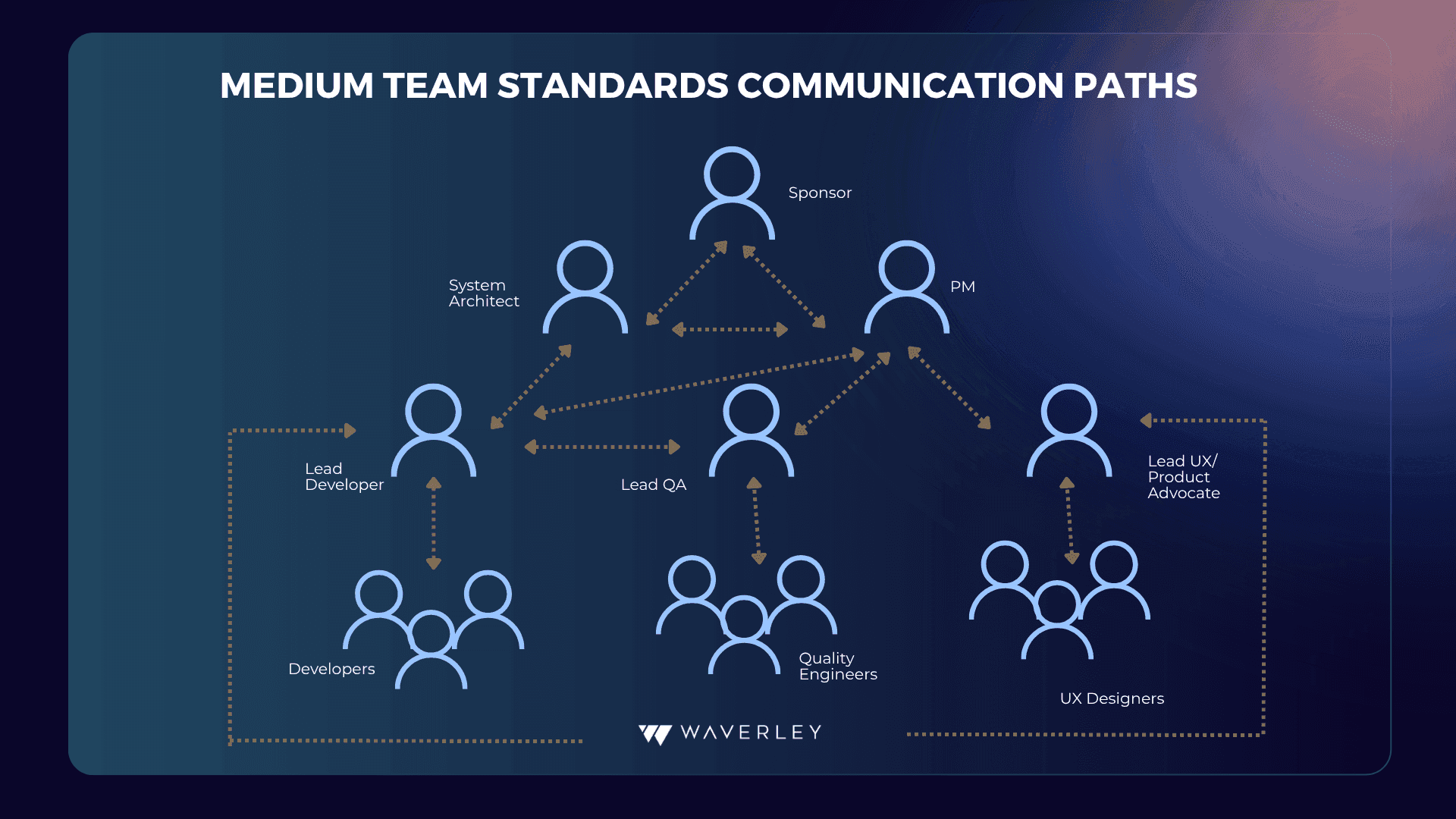
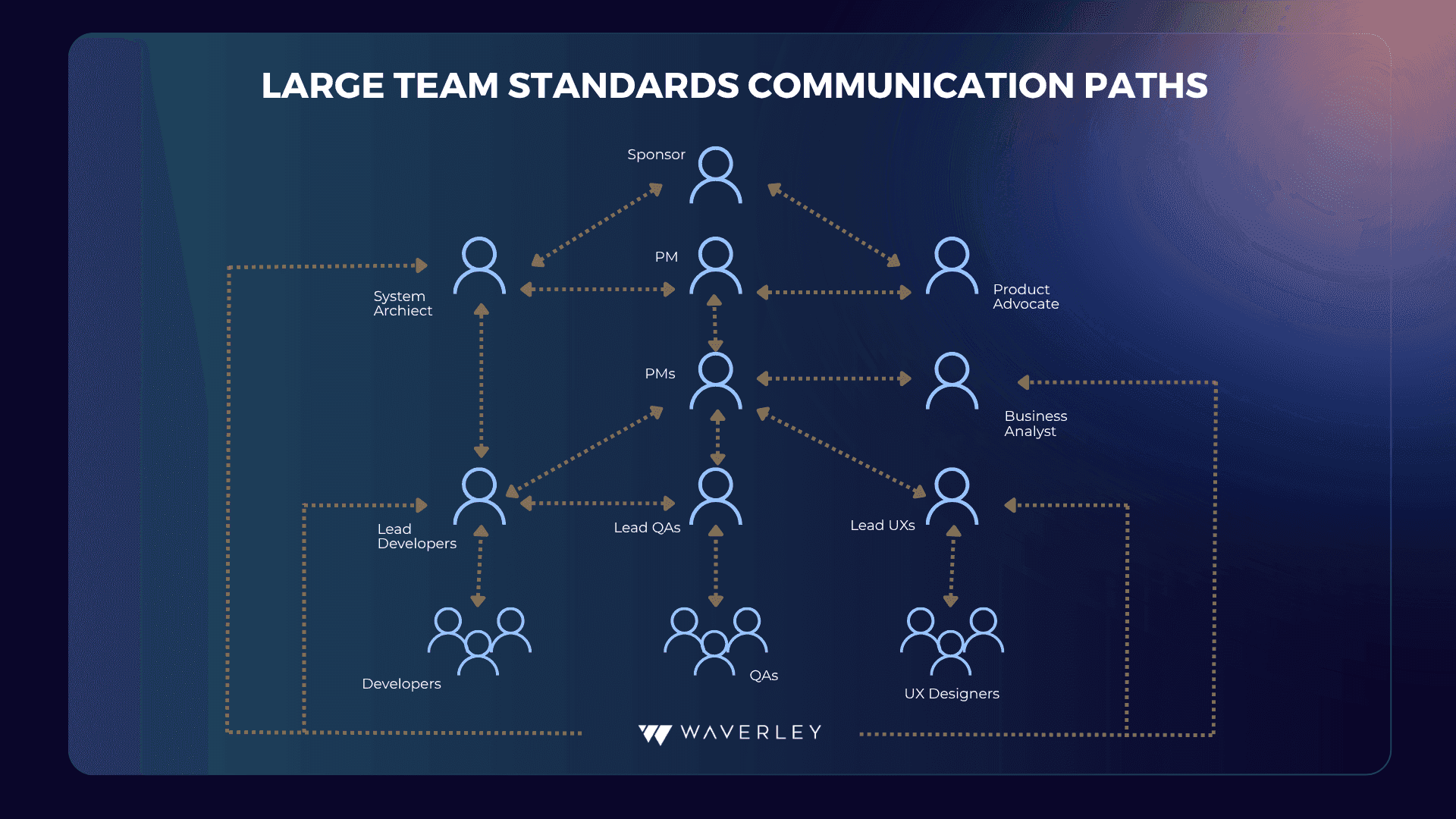
Now that we have our cast of players let’s describe the play. Recalling the old adage “All roads lead to Rome” we propose “All paths go through the Program Manager.” By this we mean that any formal communication should include the Program Manager, whose responsibility is to synthesize and distribute all important information to all project team Leads, as well as to the Sponsor and supporting roles, as appropriate.
Specifically, in formal communication, here’s who should (and shouldn’t) be approaching whom:
1) Sponsor or Client
Communicates primarily with the Program Manager and Product Advocate. May be present on team meetings and status calls, and may request status updates besides regular calls. The Sponsor should not communicate with anyone else on the team without the involvement of the Program Manager or Product Advocate. In most cases such direct communication between line-level or even Lead contributors and Sponsors results in unintended consequences and lost time.
2) Product Advocate
Communicates with the Sponsor, Program Manager, Project Manager and supporting roles like Business Analysts or SMEs. Requests for information or change of orders for the larger team from the Product Advocate should be passed through the Program Manager (or at least CC the PM).
3) Program Manager
The primary contact for the entire team, delivering regular status updates, risk assessments, etc. The Program Manager consolidates and directs communication within the team and should be included in all inter-group communications, both within a single site and across sites. The Program Manager tracks action items, escalates issues for resolution, and ensures that communications involve all needed parties.
4) Project Manager
The primary contact for a specific site (which on smaller projects may be the only site, in which case the Program and Project Manager are the same person). Tracks status and issues within his/her site and forwards these to the Program Manager. Alerts the Program Manager to cross-site issues and alerts the skill set Managers to any personnel issues within his/her site.
5) UX, Development, QA, and Technical Writing Managers
Make staffing decisions regarding who from his/her skill set is on the project team, taking into account the workload, skills, and budget. Managers may change project personnel according to project needs, notifying the appropriate Project Manager who informs the Program Manager. Skill set Managers also help to resolve any personnel issues within their site’s project team.
6) System Architect
Communicates with the Sponsor, the Program Manager, the UX and Development Leads and the Product Advocate. Guides the development team in resolving technical issues as they arise. All communication to and from the System Architect should CC the Program Manager.
7) UX, Development, QA, and Technical Writing Leads
Manage communication within their own team, reporting personnel issues to the skill set Manager and team Project Manager. The Leads communicate work status and schedules to their site’s Project Manager. Communication between Leads across sites or with other Leads should include each site’s Project Manager and the Program Manager. UX Leads often communicate directly with the Product Advocate and supporting roles (Business Analyst, SME) but here again they should include the Program Manager in their communications.
8) UX Designer, Developer, Quality Engineer, Technical Writer
These line-level roles communicate primarily within their own team. Communications with other teams and/or skill sets typically involves the Leads (for questions of larger importance), although informal communication like casual questions or confirmation can flow directly between teams without the involvement of a Lead.
9) Subject Matter Experts (SME), Business Analyst and other supporting roles
Communicate primarily with each other and with the Product Advocate and skill set Leads, especially the UX Lead, copying the Program Manager. It’s then the Program Manager’s responsibility to involve the Sponsor or System Architect when and where appropriate.