

A Control App for a Solar Power System
INDUSTRY
Manufacturing
SERVICE
Energy
CLIENT
Holu Hou
Holu Hou: A Control App for a Solar Power System
"Waverley provided cross-platform mobile applications and web apps for Energy Management in a Solar Power System."
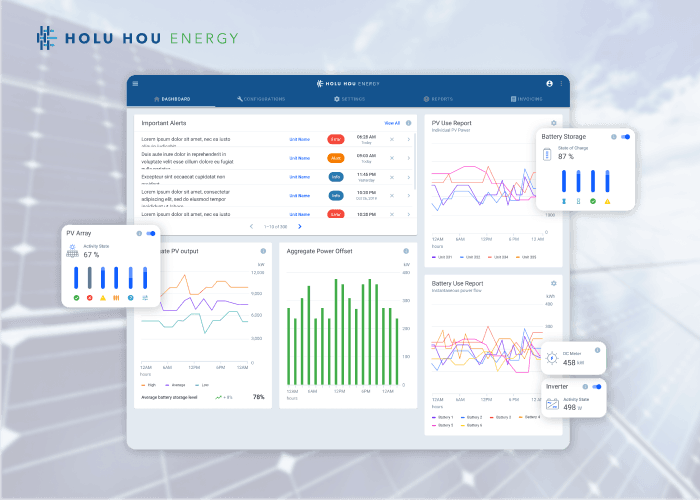
Holu Hou, a US-based solar and energy storage provider, needed to transform their residential energy systems into smart-home solutions. Waverley built four full-featured applications—iOS/Android mobile apps and web apps for both administrators and end users—enabling real-time control of solar panels, battery storage, and connected home appliances. The solution integrates IoT hardware with cloud-native architecture, real-time data processing, and a seamless user experience across platforms.
Holu Hou
The Client
Holu Hou is a technology-forward solar energy company serving residential, commercial, and industrial customers. Their mission centers on promoting renewable energy through eco-friendly, fuel-free power systems. Beyond hardware installation, the company provides ongoing maintenance and support—positioning software as a competitive differentiator. When Holu Hou realized software was essential to unlocking the full value of their solar systems, they partnered with Waverley to build the platform.
Project Analysis
Building smart-home software for energy systems introduces a unique set of constraints:
Hardware-software coordination: Waverley's software team had to deliver cross-platform applications while the client's hardware team was simultaneously developing the controller device. Misalignment between teams could sink the entire project.
Real-time reliability: Energy management systems cannot tolerate latency or data loss. System state changes must synchronize instantly across mobile and web apps, or users lose trust in the platform.
Multi-platform consistency: iOS and Android users, plus web administrators and end users, needed feature parity and identical user experience—no excuses for "the app on Android doesn't do that."
Hardware integration without hardware: The team had to test software against a physical controller that didn't yet exist, relying only on documentation and requirements.
What We Delivered
Waverley assembled a 7-person team spanning mobile, backend, DevOps, QA, and project management:
Cross-platform mobile development: Used Flutter (Google's Dart-based toolkit) to build iOS and Android apps from a single codebase, reducing development time and ensuring consistency across platforms.
Cloud-native architecture: Leveraged AWS IoT Core for device-to-app communication, AWS Kinesis for real-time data processing, AWS Cognito for secure user management, and AWS services for infrastructure (CodePipeline, CodeBuild, CodeDeploy, CloudFormation).
Hardware emulation: When the physical controller wasn't available, Waverley's engineers built an emulator—a software tool that reproduced the controller's behavior based on documentation. This allowed testing to proceed in parallel with hardware development.
Four integrated applications: Two admin apps (iOS/Android for installers and system managers) and two user apps (iOS/Android for homeowners) with identical functionality, enabling real-time monitoring of solar production, battery state, and load management across home appliances (AC, water heaters, EV chargers).
Comprehensive QA: Implemented manual testing (functional, cross-browser, mobile, UI/UX, integration, load, regression) and automated testing (Postman for API, JMeter for load testing). Achieved 70-80% test coverage across hundreds of test cases.
Outcomes & Impact
Cross-platform apps: 4 applications (iOS/Android admin & user) deployed with consistent UX and feature parity
Real-time control: Solar panels, battery storage, and home appliances controlled in real-time via WiFi or Bluetooth
Hardware integration: Seamless communication with Holu Hou's IoT controller via AWS IoT Core
User scaling: Platform designed to handle ~10,000 concurrent users managing multiple energy systems
Energy insights: Reporting, charting, and analytics on energy production/consumption; invoice generation; multi-currency support
Testing rigor: 70-80% test coverage; hundreds of test cases; hardware emulation enabled pre-device testing
Conclusion
Building smart-home software for energy management demands both technical breadth (IoT, mobile, web, cloud, real-time systems) and process rigor (hardware-software coordination, emulation, comprehensive testing). Waverley's approach of creating an emulator to unblock parallel development, selecting cross-platform tooling (Flutter) to maximize consistency, and investing in comprehensive QA resulted in a platform Holu Hou customers can trust. The project demonstrates Waverley's capability in IoT-connected consumer applications: delivering real-time reliability, hardware integration, and multi-platform UX consistency.
Let's Build Something Great.
Tell us about your project — we'll find the right path forward.