

Messaging App for the Mobile Pioneer
CLIENT
Danger
Danger: Messaging App for the Mobile Pioneer
"Find out how Waverley developed multiple products for the predecessor of the modern iPhone and Android devices."
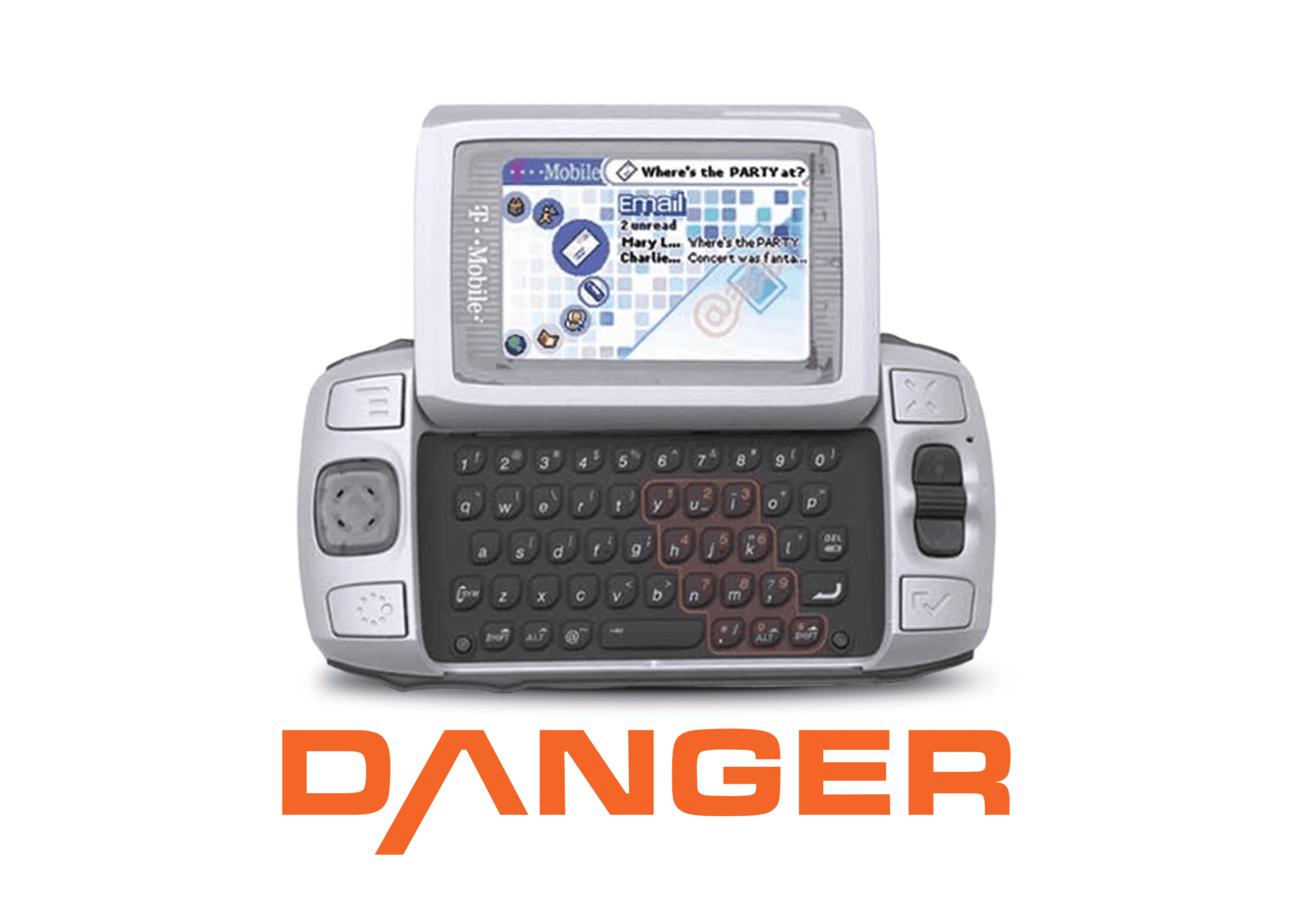
Danger built the software and services behind the Hiptop, later sold as the T-Mobile Sidekick, in the years before Apple defined the modern smartphone. To hit its cost and time-to-market targets, Danger needed to extend its own engineering capacity without slowing down.
Waverley sent a small team from Eastern Europe to work on-site in Danger's Palo Alto offices, learn Danger's codebase directly from an already-stretched engineering team, and start contributing within weeks rather than months. As the team proved its value, the engagement grew from one small group into a team working across a variety of Danger's product lines.
The relationship sits inside Waverley's own history with mobile computing's earliest days, work that began with our founder writing applications for the Apple Newton in the 1990s and continued through platforms like Danger's, years before iOS and Android existed.
Danger
Danger was an integrated mobile internet software and services company built around a handheld device called the Hiptop. Danger brought voice messaging, web browsing, and personalized services to the Hiptop years before the iPhone existed. T-Mobile later sold the device as the Sidekick, and it was also rebranded as the Mobiflip; it was produced from 2002 to 2009.
The Hiptop ran client software written in Java that stayed synchronized with back-end services Danger operated and maintained, an architecture that anticipated the app-store and always-connected model iOS and Android would later popularize.
Danger's co-founder, Andy Rubin, had previously worked at Apple and General Magic. After Danger, Rubin went on to found Android, Inc., which Google acquired in 2005. Microsoft acquired Danger's underlying technology directly in 2008.
Project Analysis
Between 2001 and 2007, in the years leading up to Apple's introduction of iOS and the iPhone, several companies were competing to establish a foothold in a smartphone category that had not yet been defined. Many of them, including Danger, relied on offshore and outsourced engineering talent to meet cost and time-to-market targets they could not hit with in-house headcount alone.
Waverley's involvement with Danger sits inside a longer company history with early mobile computing. Waverley's founder, Matt Brown, wrote applications for the Apple Newton in the 1990s, a decade before smartphones existed in any commercial form. Danger contracted Waverley for that same kind of expert, cost-effective engineering help.
For the engagement to work, it needed to be seamless to manage, cost-effective, and able to add value quickly. That meant a new outside team had to become productive on Danger's live codebase fast, with minimal hand-holding from an engineering organization that had little spare capacity to train anyone new.
What We Delivered
A Crawl, Walk, Run Model for a Fast, Low-Risk Ramp
Waverley and Danger followed a “crawl, walk, run” model rather than dropping a full team onto the project on day one.
Crawl: Proving Competence On-Site
A small initial Waverley team traveled from Eastern Europe to Danger's Palo Alto, California offices. Working alongside Danger's own engineers, the team focused first on knowledge transfer and team-building activities designed to establish technical competence and build trust before the scope of work expanded.
Walk: Learning the Codebase with Minimal Hand-Holding
The team learned Danger's codebase and development process largely on its own, an important constraint given how little spare capacity Danger's engineering organization had to train an outside team.
Run: Scaling Across Product Lines
As the team integrated into Danger's engineering organization and proved its value, Waverley grew the engagement in size and depth. What began as a single small team ended up working across a variety of Danger's product lines.
RESULTS AND OUTCOMES
A Small Team That Earned a Bigger Mandate
Danger's engagement with Waverley predates the metrics dashboards that document our more recent projects. What it documents instead is a pattern that recurs across many of Waverley's client engagements: prove competence fast, then earn more scope.
Ramp-up speed: Credited by Danger's Engineering Manager as faster than the ramp-up period typically required for an offshoring initiative.
Engagement scope: Grew from one small on-site team into a team working across a variety of Danger's product lines.
Working model: Built through direct, on-site knowledge transfer in Danger's Palo Alto offices rather than remote-only onboarding.
Historical position: One of Waverley's earliest mobile engineering engagements, predating the iOS and Android platforms that followed.
Danger's own trajectory ended when Microsoft acquired its technology in 2008 and later folded it into other projects. The pattern Waverley used to earn Danger's trust, a small proof-of-competence team growing into a broader mandate, is the same model we still use today when a client needs to extend engineering capacity on a live codebase.
CONCLUSION
A Pattern That Has Outlasted the Platform
Danger sits near the very start of Waverley's history with mobile engineering, a history that runs from the Apple Newton through the smartphone era to today's AI-accelerated product development. The lesson from Danger still holds: a small team that proves it can operate inside a client's own codebase, with minimal hand-holding, earns the right to take on more.
Let's Build Something Great.
Tell us about your project — we'll find the right path forward.