

Software Development for Steam Energy Equipment
INDUSTRY
Manufacturing
SERVICE
Energy
CLIENT
Spirax
Spirax: Software Development for Steam Energy Equipment
"Waverley was contacted by the world’s leading manufacturer of steam equipment for assistance with multiple software engineering projects."
Waverley was contacted by the world’s leading manufacturer of steam equipment for assistance with multiple software engineering projects.
Spirax
About the Client
Spirax Sarco is the global leader in high-quality products for controlling and efficiently using steam and other industrial fluids. Founded in 1888 in Great Britain, Spirax Sarco is now represented in 62 countries, with over 1300 specialists delivering solutions for 24 industries including pharma, oil & gas, and healthcare. Spirax is one of the oldest businesses in the UK, awarded for their contributions by Queen Elizabeth II. Spirax Sarco specializes in using steam effectively and manufacturing products for every part of the steam system including isolation valves, condensate pumps, pipeline ancillaries, steam traps, and control systems.
What We Delivered
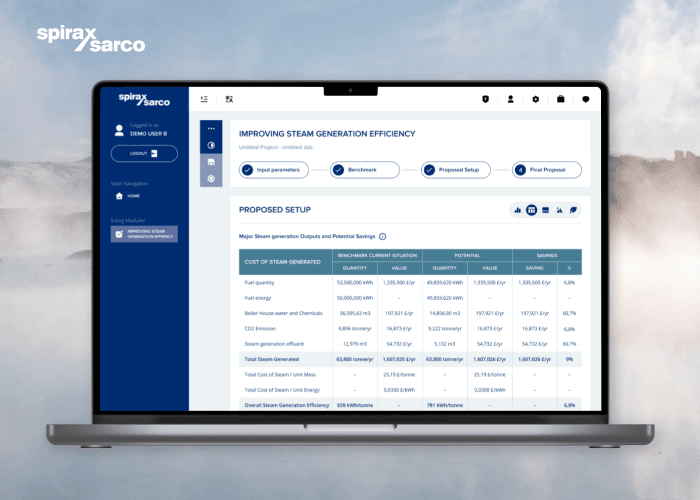
Waverley's team was responsible for the legacy system migration from the old platform to a new one. The old application was working on the old version of the Microsoft framework. Spirax needed to transfer its application to a new platform, which our team accomplished with the help of Angular development. The old version of the application could only function with the old Windows version and Internet Explorer browser, whereas the new version uses modern tablets and smartphones, simplifying manager/agent work, thus increasing sales volume.
Our specialists began by estimating the scope of work; DevOps specialists created a new work environment (Azure DevOps Server). Our team’s next step was to start the discovery phase, which included work with a wide array of industrial formulas and engineering calculations that go into steam processing. After that, the transition from the old platform to a new one started, divided into several stages. Migration is a complex and detail-oriented process, especially given that the app in question was already in use. Our team’s primary task was to migrate it smoothly without damaging the client's customer flow.
Waverley’s team worked on the migration of a steam generator module. In the meantime, our front-end Angular specialist ensured a seamless user interface on the new platform. Our team was doing “reverse engineering,” deconstructing software and architectural structures to extract design information.
The Waverley team also provided organizational (used Scrum Agile) and CI/CD practices and tools to make the development process more efficient. In this particular case, the team used Azure DevOps.
Our back-end team found the most suitable algorithm to work with the old version of the customer’s system. The next step was to decompose the process as much as possible.
The legacy system migration process included the following:
Comparing new and old versions
Re-checking the calculations
Fixing bugs and mistakes in the old calculations
Updating the code itself
This was achieved with the help of integration tests to compare calculations in the old and new versions. Performing integration tests helped our team save time and avoid syntax and logic errors. This task included many steps: taking data from the database, checking it manually, and then proceeding with the calculations. The technology our team used was Microsoft Visual Studio Unit Testing Framework.
The formula we worked on was the basis for calculating indicators of improvement throughout the production process. Our specialists worked on vapor pressure formulas and changes of state calculations (liquid and vapor), calculating over 100 formulas, facilitating new functionality in the client’s global Steam System Audit Tool platform.
Therefore, the back-end team was involved in the discovery phase working with engineering calculations and formulas.
The platform migration process was made possible through the use of specific technologies: Web API, Core, MS SQL Server DB, and Entity Framework. These technologies were used to modernize the project as much as possible. The verification process followed the migration stage.
Waverley's team used auto-tests for the verification of migration calculations. Engineers decomposed each function for calculations into many small pieces and then compared the results of both applications (old and new). The service-oriented architecture allows us to proceed with this approach and avoid migration errors.
Waverley’s team was responsible for the debugging process since the old code was not well-structured. Our team used a built-in JavaScript debugger. Our specialists also did integration tests to detect any errors where software components and system interfaces work together.
The project's work required careful planning with zero margin for error. In order to ensure no mistakes were made, Waverley provided an experienced manual QA engineer. Our specialist manually tested the application to identify bugs. His work mostly involved feature testing, using Postman API and Jira.
Outcomes & Impact
The Waverley team successfully completed the legacy migration of a steam generator module, providing our client an updated and modernized application. Our engineers also worked on the Spirax’s Metering Module migration and provided resources for a feature addition to the client’s global Steam System Audit Tool platform. Our work included many stages: estimation, discovery phase, migration processes, and testing phase. The client was satisfied with the quality of our services provided.
Let's Build Something Great.
Tell us about your project — we'll find the right path forward.