With this article, we aim to change these sad statistics by explaining the numerous benefits and possible applications of Data Science and Artificial Intelligence in fintech and banking.
Security improvements
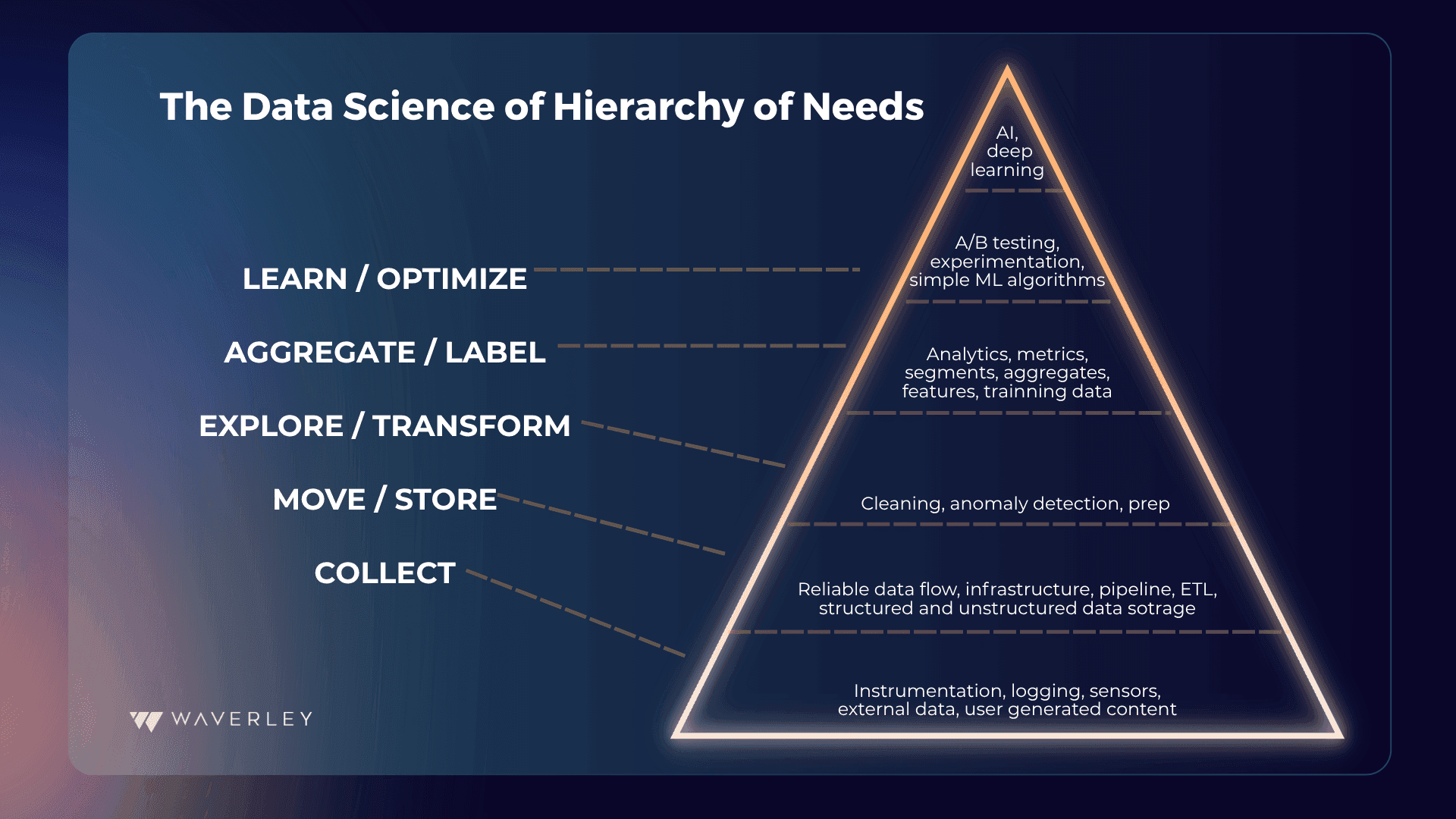
Cyber-attackers aren’t stopping inventing new ways to break into computer systems and fraudulent activities are peaking. This means financial organizations remain under the threat of leaking customers’ sensitive data and putting their reputation at risk. In addition, the financial industry is strictly regulated (FATCA, FRTB, Basel III, AML/KYC, MiFID II) which means that organizations must collect and report massive amounts of data in order to meet the rigid standards. New authentication methods, for example, biometric authentication or continuous authentication (tracking the mouse movements and keyboard rhythm), also generate data. Data science can leverage all this data for providing impressive data analytics. On this basis, the ML models and AI for fintech security solutions can be trained to spot suspicious behavior going on in financial systems, draw predictive patterns, and notify security administrators.
Tracking of user behavior and making predictions
There’s a multitude of channels businesses now use for interacting with customers: user-facing mobile applications and web portals, smart devices, social media, vending machines, ATMs, POS machines etc. At the same time, they collect user data, and this is what also makes Artificial Intelligence and Fintech companies good partners. Users’ browsing history, geo-location, interactions, interests, and preferences are invaluable sources of insights. By analyzing this data, companies learn and better understand the needs of their clients, and can adjust marketing and sales efforts accordingly.
Optimization of internal operations
Nowadays, the more cost-efficient your offer is for the customers, the more successful your company may be. But more benefits for customers might mean cutting down on operational needs. If you wish to cut operational costs (without losses), implement automation and data analytics, get some unexpected insights, and train your own predictive models with Data Science and Machine Learning. In the course of operating, you collect and store loads of internal information anyway, so why not leverage it to your benefit?
Getting an advantage over the competition
Quoting Nathan Rothshield, a German banker, businessman and financier, “The one who owns information owns the world.” When dealing with Big Data, we could rephrase it a bit to emphasize it’s important to analyze and use the information you own. Adopting AI solutions and having the insights that your competitors lack, gives you a privilege on the market, makes you stand out in the eyes of your clients as a more reliable and mature partner or service provider.