Test Execution
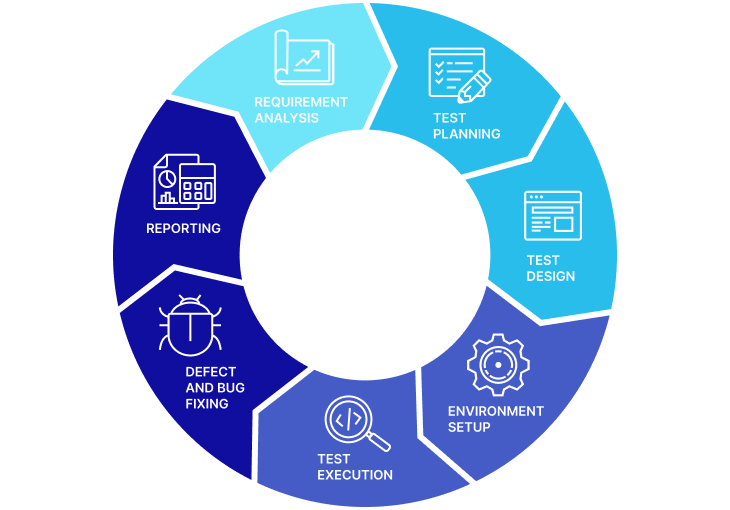
When the test plan and test cases/test scenarios are developed, Quality Assurance specialists can get down to practice. Here, based on the software development stage, they execute various types of tests.
There are many ways to test a software product. For example, one of the most widespread and straightforward test types is black-box testing. Here belong functional testing, UI/UX testing, and load testing used to check a system’s functionality, usability, stability, and performance, respectively.
When assuring the quality of software, QA engineers also develop white-box tests, designed to ensure the product’s security and the quality of code – unit tests and integration tests. Contrary to black-box testing, white-box tests require testing specialists well-versed in the system build and conception – in order to identify whether each part of the system (unit) works as intended separately and interacts with other parts (integration).
There’s also regression testing and acceptance testing. Regression tests help us ensure that the debugged or changed software element functions as it should. With acceptance testing, we check if the developed system meets the customer requirements set forth in the product specifications (yeah, we know them from the product and quality requirement analysis stage).
Defect and Bug Fixing
The effort needed for bug fixing or failure testing by a software engineer is inversely related to how well a bug or defect is reported and described by the Quality Assurance specialist. In order to describe and validate it in the best way possible, testers need to reproduce the bug (repeat it multiple times), understand and put down the specific flow of events causing it. This is the part of the QA activities when fine-tuned communication with the development team is particularly important.
Reporting and Documenting
Tracking and reporting are two more key elements of the software testing process. Various test tools help us boost the accuracy and speed of test management. These instruments take off the burden of excessive manual tasks and help avoid mistakes. To name a few, our Quality Assurance and Quality Control engineers use TestRail, Xray, Zephyr, and TestLink to manage the testing process, collaborate with fellow engineers, and let other project stakeholders track its progress.
Also, QA teams continuously create and follow testing documentation. Testing documentation may include test policy, test strategy, test plan, test scenario, test cases, defect reports, and test summary report, for example. All this makes the planning, execution, and review of the QA activities well-organized and verifiable. It also helps to provide more precise estimations for the required test effort and resources, test coverage, testing progress, and so on.
Recently, our Senior QA Engineers presented a more detailed overview of the software testing process.