Logo
Artificial Intelligence

The New Software Engineering Bottleneck Isn't Coding

Engineering teams write far more code with AI, yet business throughput stays flat. When implementation is no longer scarce, the bottleneck moves to judgment-heavy work: deciding what to build, specifying it clearly, and validating it at scale.

WT
Waverley Team
October 23, 20269 min read
Share
The New Software Engineering Bottleneck Isn't Coding

For most of software's history, the scarce resource was implementation capacity. There were always more features, fixes, and integrations than engineers to write them, so most productivity efforts aimed at one thing: helping developers produce working code faster.

AI coding tools and AI coding agents have quickly changed that equation. Generating a function, a test suite, or a first-pass refactor is now cheap. Yet many engineering leaders are noticing something uncomfortable: their teams write far more code, but the business isn’t shipping proportionally more value.

The reason is a familiar idea from systems thinking. When you remove one constraint, the bottleneck moves. In AI-assisted software development, the software engineering bottlenecks have shifted away from typing code and toward everything around it: deciding what to build, defining requirements, managing context, making architectural decisions, prioritizing, validating output, and leading teams through the change. This article looks at where those constraints now sit, what the data says, and how engineering organizations can respond.

AI Made Code Cheap; It Didn't Make Software Cheap

Adoption is no longer the question. Google Cloud's DORA research found that nearly 90% of technology professionals now use AI in their work , and more than 80% believe it has increased their productivity. Stack Overflow's 2025 survey puts AI tool use at 80% of developers.

At the individual level, the output gains are real. Faros AI's telemetry across more than 10,000 developers and 1,255 teams found that engineers using AI merged 98% more pull requests. The same research found that PR review time rose 91%, and company-level delivery metrics stayed flat. Faros calls this the AI productivity paradox: individual developer productivity goes up, organizational throughput does not.

Part of the explanation is simple arithmetic. Atlassian's State of Developer Experience 2025 report found that developers spend only 16% of their time coding. Most of their week goes to finding information, coordinating with other teams, switching between tools, and waiting on decisions. The same report found that while 68% of developers save more than 10 hours a week with AI, 50% lose 10 or more hours a week to organizational inefficiencies. Accelerating a small slice of the work by a large factor still leaves most of the cycle untouched.

In other words, AI in software engineering has mostly optimized the step that was already the smallest part of the job. The constraint has moved downstream and upstream.

Where the Software Engineering Bottlenecks Moved

When implementation capacity stops being scarce, the work that determines whether that capacity produces value becomes the constraint. In practice, we see seven areas absorbing the pressure.

Deciding What to Build

When building is slow and expensive, weak ideas get filtered out by cost alone. When an AI coding agent can produce a working prototype in an afternoon, that filter disappears. Teams can now build the wrong thing faster than ever, and the backlog fills with half-finished features nobody validated with users.

The scarce skill becomes product judgment: framing the problem correctly, defining what success looks like, and saying no. Faster software development automation raises the cost of a bad decision because a bad decision now ships with more attached code.

Requirements and Specification

AI coding tools are literal. They do what they are told, and they fill gaps with plausible guesses. Stack Overflow found that the top frustration for 45% of developers is "AI solutions that are almost right, but not quite," and 66% say they spend more time fixing almost-right AI-generated code.

Much of "almost right" is really "under-specified." Clear acceptance criteria, edge cases, non-functional requirements (performance, security, and compliance), and explicit constraints have become direct inputs to the code generation process. Writing a precise specification is increasingly the highest-leverage engineering task on a ticket.

Context

An AI model only knows what it can see. It does not know why a service was split in two years ago, which customer depends on an undocumented API behavior, or that a "temporary" workaround is load-bearing. Atlassian's research found that finding information (about services, documentation, and APIs) is the top source of developer friction, and the same gap limits AI coding agents.

Context engineering, meaning the deliberate curation of architecture decision records, coding standards, domain glossaries, repository conventions, and system documentation so that both humans and agents can use them, is becoming core engineering infrastructure rather than a documentation chore.

Architecture

AI coding tools are good at local optimization: making one file, function, or service work. They are much weaker at system-level trade-offs, such as where a boundary belongs, how data should flow, or what a choice means for scalability, cost, and maintainability three years from now.

When code volume increases, architectural drift accelerates. Faros AI's 2026 data on high-AI-adoption teams shows PR size up 51%, and code churn up roughly 10x. Without strong architectural guardrails, AI-assisted software development can produce a large, inconsistent codebase faster than any team can reason about it. Architects and senior engineers become the people who keep the system coherent, and their time becomes a constraint.

Prioritization

If almost any item in the backlog can be implemented quickly, the backlog stops being a queue and becomes a portfolio decision. Engineering productivity is no longer limited by "how many tickets can we close" but by "which tickets are worth closing, in what order, and what will we deliberately not do."

This puts more pressure on product and engineering leadership to align on outcomes. Faster delivery of low-priority work is not productivity; it is a more efficient way to accumulate maintenance cost.

Validation

Validation is where the bottleneck is most visible in the data. Code review, testing, security checks, and release verification were sized for human-paced development. AI-generated volume overwhelms them.

Faros AI's Q2 2026 telemetry across 22,000 developers compared high- and low-AI-adoption teams and found 5x median review time, 54% more bugs per developer, and nearly 3x more incidents per PR, alongside real throughput gains such as 66% more epics completed. DORA's 2025 research similarly found that AI adoption now correlates with higher delivery throughput, but software delivery instability continues to rise.

Trust compounds the problem. Only 29% of developers say they trust AI output accuracy, according to Stack Overflow. That skepticism is healthy, but it means every generated change needs a human or an automated check that someone actually trusts. Teams that have not invested in test automation, CI/CD pipelines, and review practices end up with a growing queue of unverified code.

Technical Leadership

DORA's central 2025 finding is that AI acts as an amplifier: it magnifies the strengths of high-performing organizations and the dysfunctions of struggling ones. The difference came from organizational, not individual, practices, such as clear AI policies, healthy data ecosystems, quality internal platforms, and a user-centric focus.

That makes technical leadership a bottleneck in its own right. Someone has to set AI usage guidelines, decide which workflows to automate, redesign review and release processes, protect security and IP, and coach engineers whose role is shifting from writing code to directing and verifying it. Atlassian found that 63% of developers say leaders do not understand their pain points, up from 44% a year earlier. In a period of fast change, that gap is expensive.

What We Still Don't Know

It is worth being precise about the evidence, because the AI developer productivity debate is full of confident claims in both directions.

  • Perceived speed and measured speed differ. METR's randomized controlled trial with experienced open-source developers found that, with early-2025 tools, AI use made tasks take 19% longer, even though developers believed they were faster. METR's 2026 follow-up suggests developers are likely more sped up with newer tools, but describes its own data as weak evidence on the size of that change. The lesson isn't that AI slows teams down; it is that self-reported gains are unreliable and need measurement.
  • Results vary by context. Greenfield work, well-documented codebases, and well-defined tasks tend to benefit more than complex legacy systems with lots of implicit knowledge.
  • Tools are moving fast. Most published studies evaluated tools that newer AI coding agents have already superseded, and those agents increasingly take on longer, multi-step tasks. That further increases implementation capacity, which, if anything, makes downstream constraints more pressing.

How to Rebalance Engineering Productivity Around the New Constraints

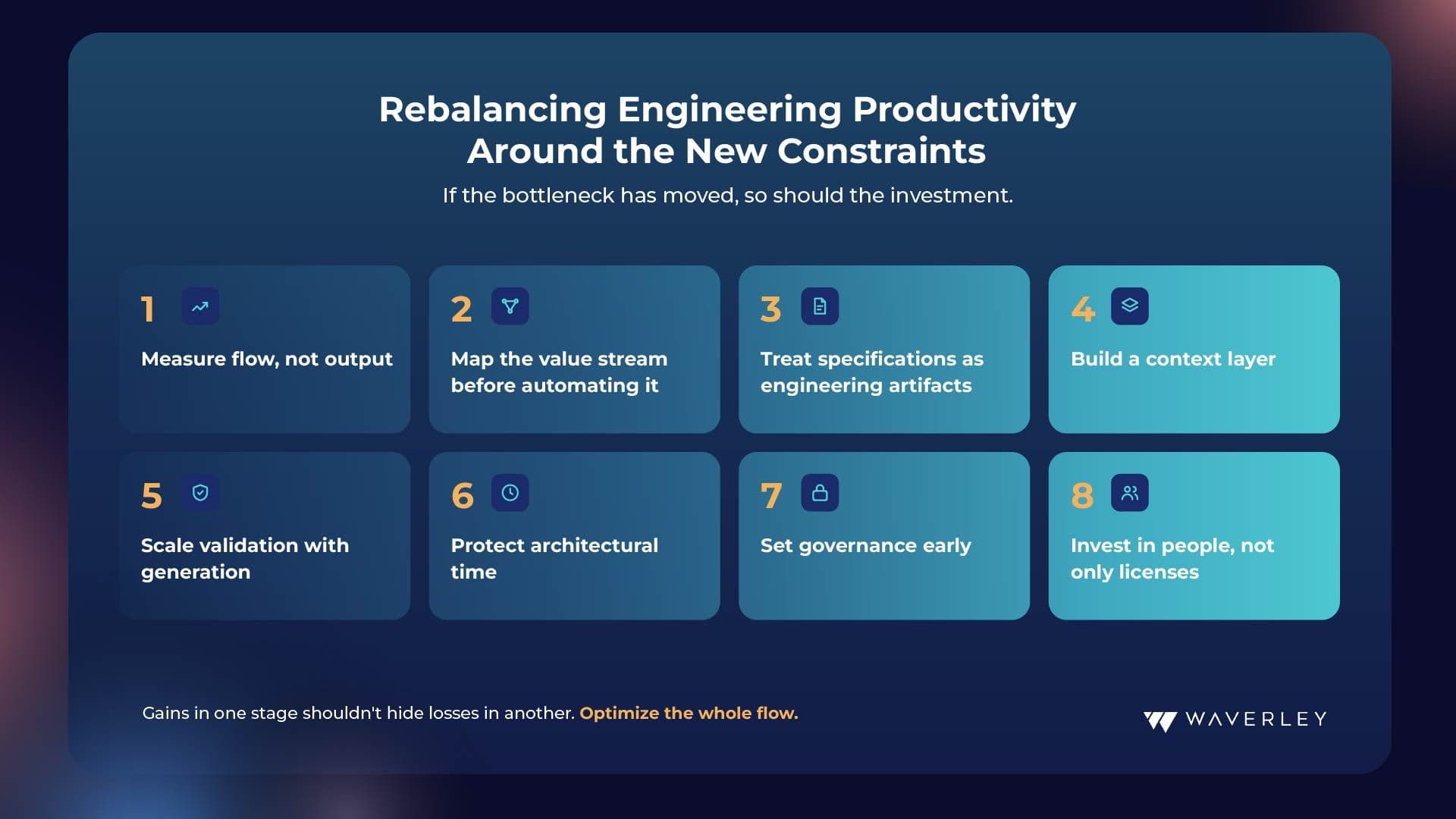
If the bottleneck has moved, so should the investment. A few practical recommendations for engineering leaders:

  1. Measure flow, not output. Lines of code, PR counts, and "AI acceptance rate" reward volume. Track lead time, cycle time, deployment frequency, change failure rate, and time-to-restore before and after AI adoption, so gains in one stage don't hide losses in another.
  2. Map the value stream before automating it. Identify where work actually waits: requirements clarification, review queues, test environments, and approvals. Point AI and engineering workflow automation at those stages, not only at the IDE.
  3. Treat specifications as engineering artifacts. Invest in templates and habits for acceptance criteria, constraints, and edge cases. Better tickets improve both human and AI output.
  4. Build a context layer. Maintain architecture decision records, coding standards, and system documentation in a form that AI software engineering tools can consume. Keep it current; stale context produces confident, wrong code.
  5. Scale validation with generation. Expand automated testing, static analysis, and security scanning; keep PRs small; and use AI-assisted review to triage, while leaving accountability with human reviewers.
  6. Protect architectural time. Give senior engineers explicit capacity for design reviews and guardrails instead of absorbing them into delivery work.
  7. Set governance early. Define where AI may be used, how teams review generated code, and how they handle IP, data, and security, so teams can move quickly with confidence instead of improvising.
  8. Invest in people, not only licenses. The engineer's role is shifting toward problem framing, system thinking, and verification. Training and coaching for those skills is part of AI engineering adoption.
Infographic: Rebalancing engineering productivity around the new constraints. AI made code generation fast and cheap; the new constraints are specs, context and validation. Eight steps follow.

Conclusion

AI has made implementation capacity abundant. That is a real shift, but it does not automatically translate into better software or faster business outcomes. The software engineering bottlenecks now sit in judgment-heavy work: choosing the right problem, specifying it well, giving systems and agents the right context, keeping the architecture coherent, prioritizing ruthlessly, validating output at scale, and leading teams through a changing definition of engineering work.

Organizations that keep measuring productivity by how much code they produce will see busier teams and flat results. Those that redesign their delivery systems around these new constraints are more likely to turn AI in software engineering into measurable gains in throughput, quality, and time-to-market.

Turn AI Coding Gains Into Engineering Throughput

Our AI Productivity & Engineering Transformation is a focused, four-to-six-week engagement. We assess where your delivery workflow slows down, embed AI-assisted practices across coding, review, testing, and CI/CD, set governance and guardrails, and measure impact against your baseline. Find out how it works.

About the author & stay in touch
Stay up to date

Subscribe to Waverley's newsletter and stay up to date with the latest articles.

Let's Work Together

Ready to build something great?

Let's talk about your project.

Contact Us