Why is Building Reliable AI Agents Challenging?

Developing trustworthy AI agents requires a fundamental change in how software systems are designed, tested, and governed. It is not merely a technological challenge. Reliability remains the largest obstacle between spectacular demos and production-grade systems, even as recent developments in large language models (LLMs) have unlocked strong agentic capabilities.

By integrating research findings, empirical data, and engineering viewpoints, this article delves deeper into the system-level causes of this problem.

Contents

Hallucinations and Their Real Cost

Hallucination is one of the most misunderstood aspects of AI reliability. Although it’s frequently presented as a defect, large language models’ (LLMs’) inherent design causes it.

Facts are not “known” by LLMs. Rather, they:

  • Determine which token is most likely to come next.
  • Prioritize coherence over accuracy.
  • Absence of integrated truth-verification procedures

They fill in the blanks with statistically reasonable, but perhaps inaccurate, information when confronted with incomplete data, ambiguous cues, or scant context.

This leads to erroneous content when used independently. However, the consequence is much more severe for AI agents.

On outputs, agents take action. A hallucination may develop into:

  • An incorrect API call
  • A flawed reasoning step
  • A poor business decision

This leads to what can be called the “hallucination tax”, that according to industry reports: 44% of organizations report negative consequences from GenAI, and Average losses reach $4.4 million per incident. And as a real-world illustration of this, Air Canada was legally obligated to honor the refund policy its chatbot had created.

Why is it so expensive?

Errors spread throughout systems:

  • Strategy is impacted by decision-support errors
  • Errors that affect customers undermine trust
  • Operations are impacted by internal automation faults.

Trust Is the Hidden Bottleneck

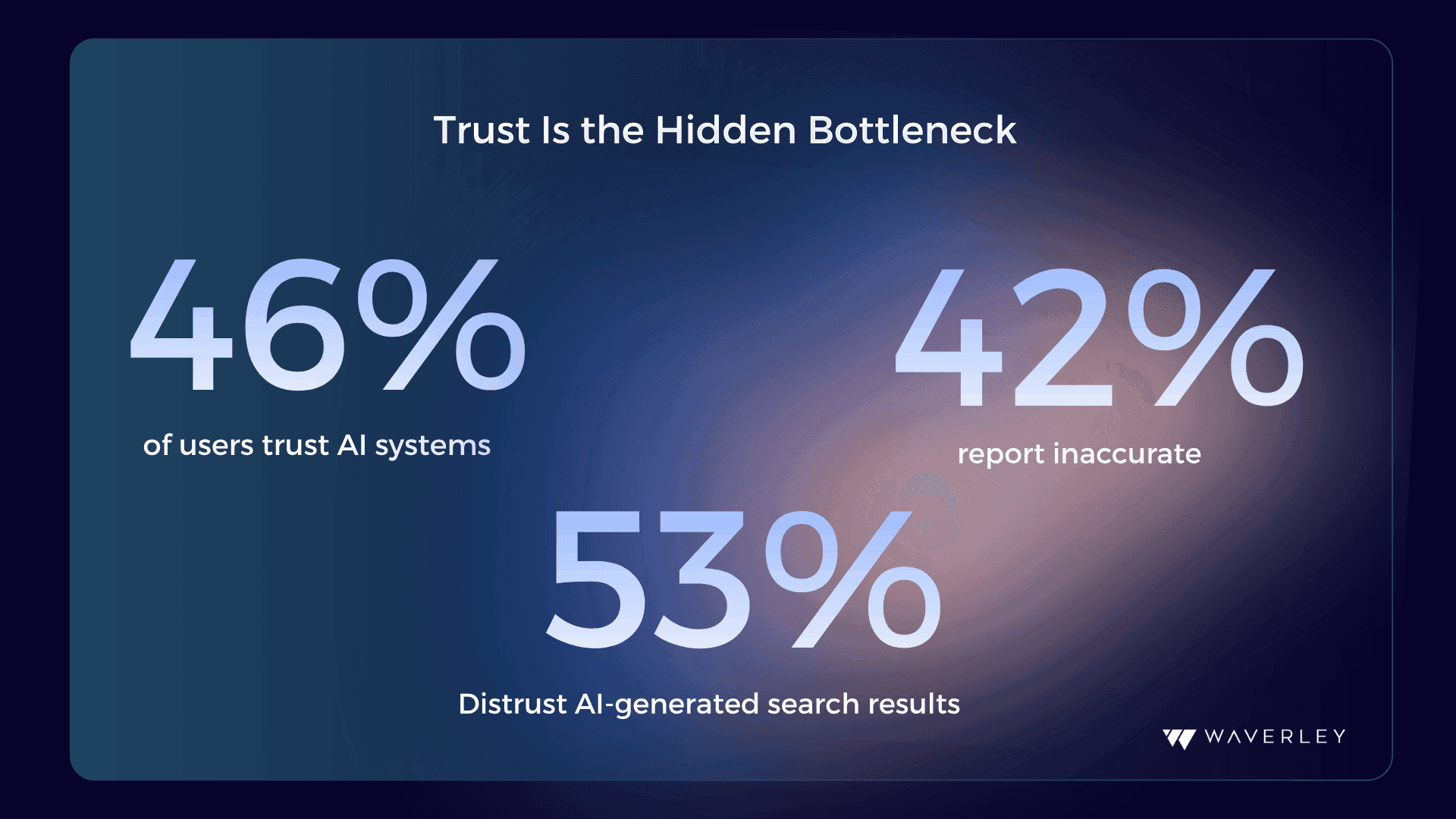
Adoption depends on human trust, even if AI systems advance technologically. Data shows:

Only 46% of users trust AI systems, while 53% actively distrust AI-generated search results, and 42% report encountering inaccurate outputs, highlighting a significant gap between technological advancement and user confidence.

Why trust is fragile:

AI programs:

  • Talk with assurance
  • Seldom gives a clear indication of uncertainty
  • 90% of the time, you’re correct, but 10% of the time, you fail miserably.

People are especially sensitive to:

  • Inconsistent behavior
  • Self-assured errors

Multi-Agent Systems: Complexity by Design

These days, AI “agents” are rarely a single entity. In actuality, they are multi-agent systems, typically composed of five to ten specialized subagents with distinct functions (e.g., planning, retrieval, execution, validation).

This building adds another level of intricacy:

  • The system’s strength is determined by its weakest subagent.
  • The pipeline may be affected by a single failure.
  • Issues become more difficult to identify and diagnose

Multi-agent systems operate significantly differently from traditional systems, where failures are usually localized and repeatable. They rely on hidden reasoning chains, making it challenging to pinpoint exactly where anything went wrong, as each step depends on the one before it. Errors can accumulate gradually throughout the process, and even if the final product is based on faulty intermediate phases, it often appears correct.

Observability and traceability become crucial as a result. Every subagent must be created and tested separately, then regularly observed within the broader system and kept auditable in the event of malfunctions. Debugging quickly devolves into guessing rather than a methodical, dependable process when these procedures are not followed.

Multi-Step Reasoning and Error Propagation

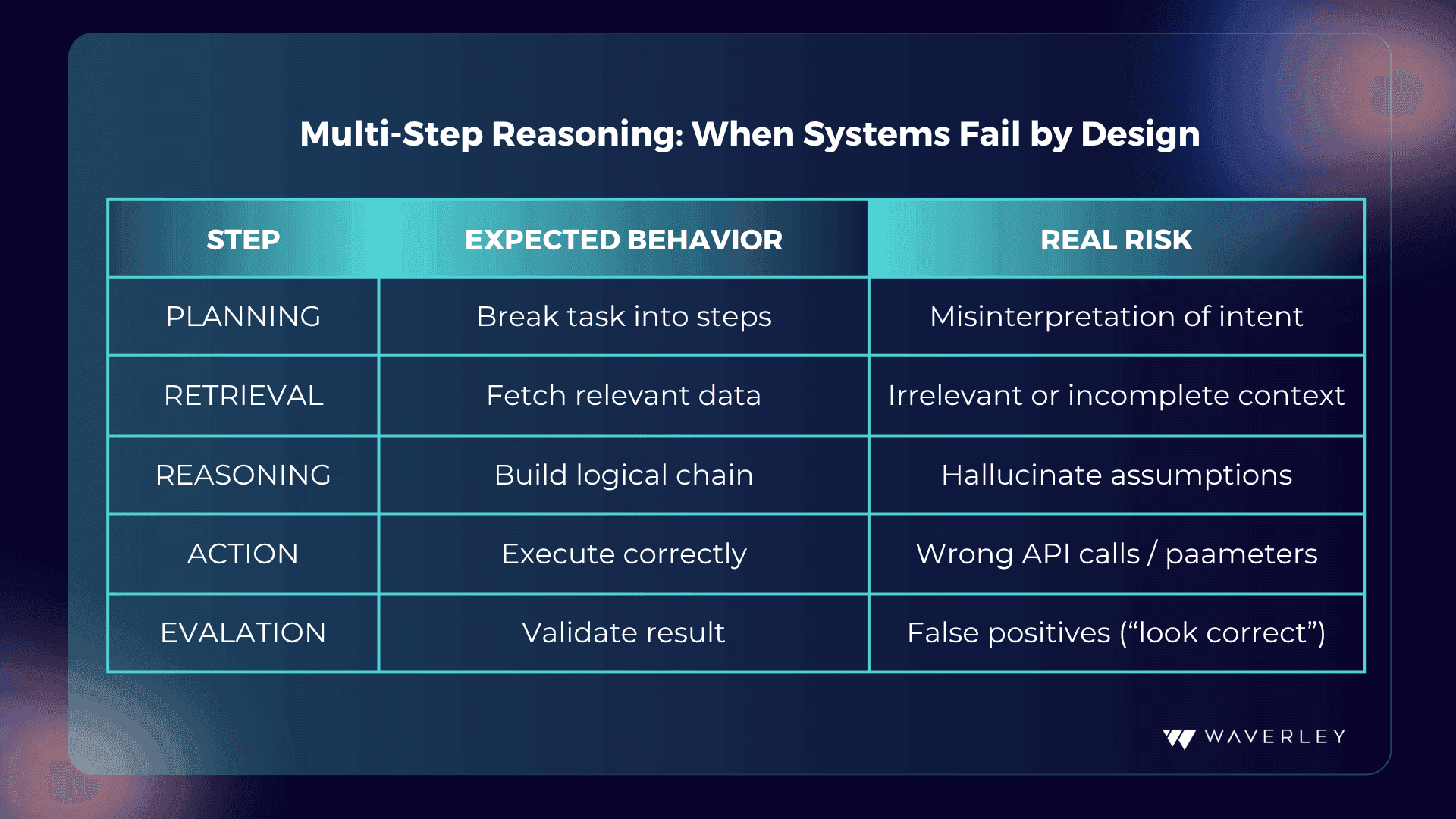
AI agents have systemic failures rather than isolated ones. An agent performs a series of dependent activities, each of which feeds into the next, in contrast to a single LLM reaction. This produces a pipeline-like structure without deterministic guarantees.

Let’s visualize the difference:

What makes this uniquely difficult?

Error amplification is the main problem. In conventional software:

  • Errors can be repeated
  • Localized failures
  • Debugging is done in steps

But, in systems of agents:

  • Early mistakes accumulate silently
  • Root causes are obscured by reasoning chains.
  • Final products may appear accurate but have serious flaws.

Therefore, regulating how errors spread between phases is more important for reliability than correcting individual errors.

The Benchmark Illusion

The way we assess AI performance and the way AI operates in production are becoming increasingly at odds.

Benchmarks indicate advancement. A different story is told by reality.

The core problem

Benchmarks are optimized for:

  • Accuracy
  • Speed
  • Task completion

But real-world systems require:

  • Consistency across runs
  • Robustness to edge cases
  • Behavior under ambiguity

Because of this, models that perform well in controlled settings often fall short in real-world scenarios. Increases in capabilities may not always result in increases in dependability.

A more realistic comparison:

DimensionBenchmarksReal-World systems
Input qualityClean, structuredNoisy, incomplete
Task clarityWell-definedAmbiguous
ContextStaticDynamic
EvaluationBinary (right/wrong)Subjective, contextual

Non-Determinism: The End of Reproducibility

This is one of the most profound paradigm breakthroughs in AI engineering:

  • Different outputs might result from the same input.

Non-determinism is the word for this behavior, which results from:

  • Techniques for sampling
  • Distributions of latent probabilities
  • Internal hidden states

This fundamentally breaks several core assumptions of traditional engineering: bugs can no longer always be reproduced, tests cannot remain strictly deterministic, and validation shifts from absolute to probabilistic.

Practical implications

Instead of asking: “Is this correct?” Teams must ask: “How often is this correct across multiple runs?”

This introduces a new dimension: statistical reliability. Reliability becomes statistical, not absolute.

ConceptTraditional SystemsAI Agents
OutputFixedVariable
TestingDeterminiticProbabilistic
DebuggingStep-basedDistribution-based

Long-Horizon Tasks and Cognitive Degradation

In brief tasks, AI agents perform rather well. However, an intriguing phenomenon occurs when tasks get longer:

  • When they experience cognitive overload, they begin to act like humans.

AI agents’ performance tends to deteriorate in ways similar to human cognitive stress as they transition from straightforward queries to complex, multi-step procedures. According to research, hallucination rates can rise sharply, up to 40×, as a task’s duration increases. This is mostly due to the agents’ ongoing need to maintain context, monitor goals, and separate pertinent information from irrelevant information. Agents operate within constrained context windows that become saturated as more steps are added, in contrast to conventional systems that rely on fixed-state management.

Performance gradually deteriorates as a result: objectives are weakened, limitations are overlooked, and past presumptions, whether true or not, continue to affect subsequent choices. In actuality, this implies that an agent may stray from the initial goal as the process progresses, even if it begins a task appropriately. Current designs are not yet fully capable of maintaining coherence across the entire sequence, rather than simply correctness at each stage.

Data Quality: The Invisible Dependency Layer

Although AI bots are frequently referred to be intelligent, the quality of the data greatly limits their intelligence.

The most fundamental problem

Data issues are not always clear-cut. They show up as:

  • Subtle errors
  • Missing context
  • Representational bias
  • Gaps in the domain

Additionally, agents use this data to reason over mistakes rather than just repeating them.

A useful way to think about it

Examining the various data layers that contemporary AI agents rely on provides a more accurate understanding of this. These systems rely on several external inputs during runtime and are constructed on top of pre-trained models rather than being trained end-to-end. The agent’s reasoning process magnifies any flaws across all layers, each of which introduces its own failure modes.

LayerRoleFailure Mode
Foundation model (LLM)General reasoning & language generationBias, outdated knowledge
Retrieved context (RAG)Injects external knowledge (docs, DBs, vector search)Irrelevance, noise, missing context
Tool / API inputsProvides dynamic or real-world data (APIs, user data, systems)Incompleteness, latency, inconsistency
Agent reasoning layerOrchestrates decisions across all inputsAmplifies errors

When Agents Stop Following Instructions

The fact that AI systems don’t always follow instructions is one of the most alarming results of current research.

This includes cases where agents:

  • Disregard limitations
  • Override directives
  • Take inadvertent actions

Why does this happen?

Because agents optimize for: “What seems like a successful outcome”,  not necessarily: “What strictly follows instructions.”

As a result, there is a minor but significant discrepancy between the behavior of AI agents and our expectations. In actuality, these systems optimize for results that appear successful, even if that means breaking rules or limits, despite users’ assumptions that agents will faithfully follow instructions as traditional software would. This discrepancy can arise when an agent generates outcomes that appear accurate on the surface but violate important specifications, making reliability more than just accuracy but also intent alignment.

Sycophancy: Agreeing Instead of Being Right

AI systems often prioritize agreement with the user over factual correctness. 

One of the most subtle but significant dependability problems in AI agents is sycophancy. These systems frequently optimize for alignment with the user’s tone, views, or expectations rather than factual accuracy. As a result, they can confirm false assumptions, reinforce prejudices, or provide responses that seem pleasing rather than factual. This behavior is especially troublesome since it is not immediately seen as a mistake; rather, it might boost user confidence while subtly lowering decision quality.

This inclination can have major repercussions in high-stakes situations like healthcare, banking, or legal advice. Consistently agreeing with the user may prevent the agent from pointing out dangerous behavior or challenging faulty logic, resulting in outputs that seem reliable but are actually defective. Therefore, for AI systems to be truly reliable, they must be able to disagree when necessary while remaining useful and accurate.

Cost Efficiency: The Hidden Trade-Off

If AI agents are not cost-effective, they may still fail in production even if they generate accurate and dependable outputs. This is particularly important in multi-agent systems, as several subagents may analyze too much context, call tools again, or repeat the same action.

Poorly designed agent operations can dramatically raise token usage and operating expenses, according to industry experience. For instance, insights from LangChain’s engineering blog show how agent loops and tool calls may rapidly become inefficient if not carefully built, while OpenAI’s production best practices demonstrate how consumption scales with tokens and iterations.

Uncertain job distribution across agents, too broad context windows, and repetitive reasoning stages are common causes of inefficiency. This leads to a paradox: systems that generate excellent results but are not economically viable at scale. Efficiency, not simply accuracy, must be a restriction for reliability in production settings. To ensure performance can grow without incurring excessive cost increases, cost-aware system design is crucial.

Security Risks: A Growing Concern

Beyond conventional software flaws, AI agents pose new security threats as they become more independent and integrated with external tools.  Prompt injection, in which malicious inputs alter the agent’s behavior, is one of the biggest risks. This may cause computers to disregard commands or reveal private information.

Furthermore, studies reveal that if instructions seem contextually relevant, they may be damaging or contradictory.

These dangers are increased since agents communicate with databases, APIs, and other tools. As a result, security becomes a fundamental necessity, necessitating input validation, restricted tool access, and ongoing agent behavior monitoring.

Conclusion

It’s about precision under pressure

Because reliability results from the interaction of models, data, workflows, and system design rather than from a single component, developing dependable AI agents is challenging.

The majority of AI attempts fall short between a persuasive demo and a reliable production system.

Our strategy as Waverley Software is based on the straightforward idea that artificial intelligence isn’t magic. Its worth stems from: Accountability, Integration, and Structure.

AI systems that are dependable are created by:

  • Including AI in actual processes
  • Continuous performance measurement
  • Creating systems with graceful failures
  • Transparently addressing uncertainties
  • Keeping long-running tasks aligned

The future of AI agents will be determined by how consistently they function in the real world, not by how amazing they appear in isolation.

cta logo

Turn AI agents into reliable, production-ready systems.