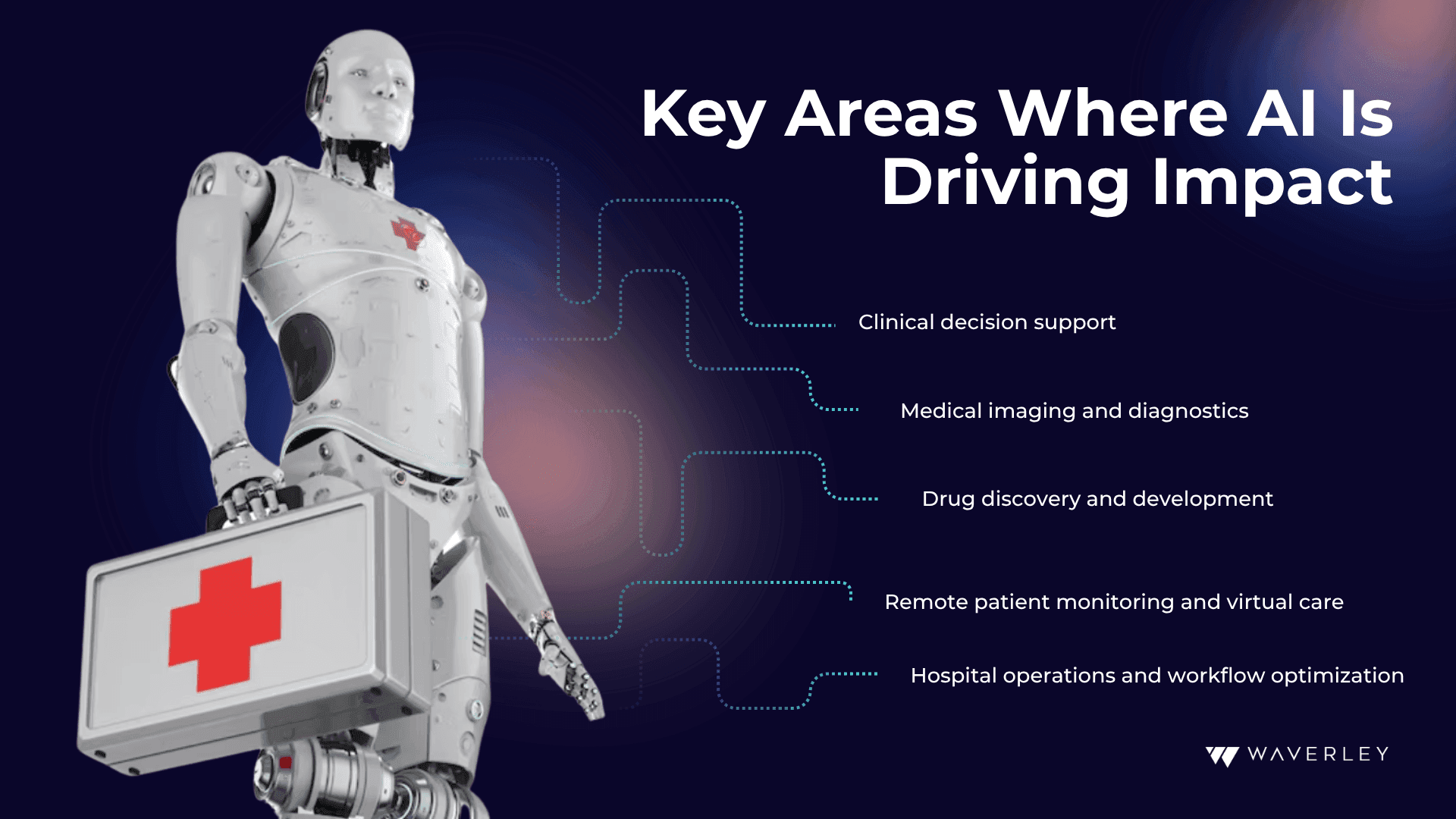
AI has enormous potential in the healthcare industry, but its successful application requires a methodical, planned approach. Because they focus only on the technology, not the environment that supports it, many healthcare companies are unable to fully benefit from AI.
When implementing healthcare AI technologies, healthcare organizations should adhere to the following important best practices.
- Building a strong data foundation
The quality of the data used to train AI systems determines how effective they are. Clinical records, imaging data, lab findings, genomic data, and real-time monitoring streams are just a few of the extremely complex datasets that healthcare organizations handle.
In order for healthcare organizations to implement machine learning effectively, they need to:
- Make sure all systems use the same data.
- Increase platform-to-platform data interoperability
- Put safe data governance models into practices
- Preserve excellent labeled datasets.
One of the biggest obstacles to implementing AI in healthcare systems is data fragmentation. Integrated data architectures that can enable sophisticated analytics and predictive modeling are usually necessary for modern AI endeavors.
Every day, healthcare systems generate enormous amounts of clinical data, but much of it is wasted due to data silos and interoperability issues.
- Cross-functional collaboration (clinicians + engineers + data scientist)
Cross-disciplinary cooperation is one of the most important factors for the successful application of AI in healthcare.
Healthcare AI systems need to align with clinical workflows and medical decision-making procedures, unlike those in other industries. This calls for cooperation between:
- Medical professionals and clinical specialists
- Engineers of software
- Researchers in AI
- Scientists of data
- Regulatory experts
The resulting AI healthcare applications are more precise, practical, and in line with actual clinical needs when these teams collaborate from the very beginning of development.
- Responsible AI governance
AI systems used in healthcare work in highly controlled settings. Governance frameworks must be established by organizations to guarantee safety, equity, and transparency.
Responsible AI tactics ought to consist of:
- Mechanisms for model explainability
- Procedures for detecting and mitigating bias
- Ongoing performance evaluation
- Controls for regulatory compliance
- Protection of data privacy
This is especially crucial for systems that use AI for clinical decision support or medical diagnosis, as inaccurate predictions can directly affect patient outcomes.
The need for varied and representative datasets is underscored by research showing that biased datasets can lead AI systems to produce inconsistent predictions across demographic groups.
- Incremental implementation strategies
Healthcare companies benefit from starting with specific applications where AI can provide quantifiable value rather than trying to implement large-scale changes right away.
Typical places to start are:
- Medical imaging with AI
- Optimization of clinical workflow
- Analytics for predictive healthcare
- Automation of documentation driven by AI
- Systems for remote monitoring
Organizations can expand their AI efforts to other departments and healthcare services after proving their effectiveness in these areas.
The success rate of implementing AI in healthcare initiatives is considerably raised by this stepwise approach.