Logo
Cloud

SaaS Development in 2026: From Cloud Applications to Intelligent Platforms

Discover how SaaS has evolved beyond cloud computing, with AI-native platforms, intelligent automation, and agentic experiences driving the next generation of software.

Michelle Galarza
Michelle Galarza
Content Writer
August 5, 202611 min read
Share
SaaS Development in 2026 From Cloud Applications to Intelligent Platforms

The SaaS sector has moved into a whole new stage. In 2024, cloud migration, scalability, and subscription-based business models dominated discussions about Software-as-a-Service. The industry in 2026 is being characterized by something much larger: intelligence, even though those principles are still crucial.

The development, pricing, and consumption of SaaS solutions are being radically altered by artificial intelligence, autonomous agents, and outcome-driven software experiences.

Businesses no longer inquire: "Should we move to SaaS?". Rather, they are inquiring: "How can our software become smarter, more autonomous, and deliver better outcomes?"

A new generation of AI-native SaaS systems is emerging as a result of this change.

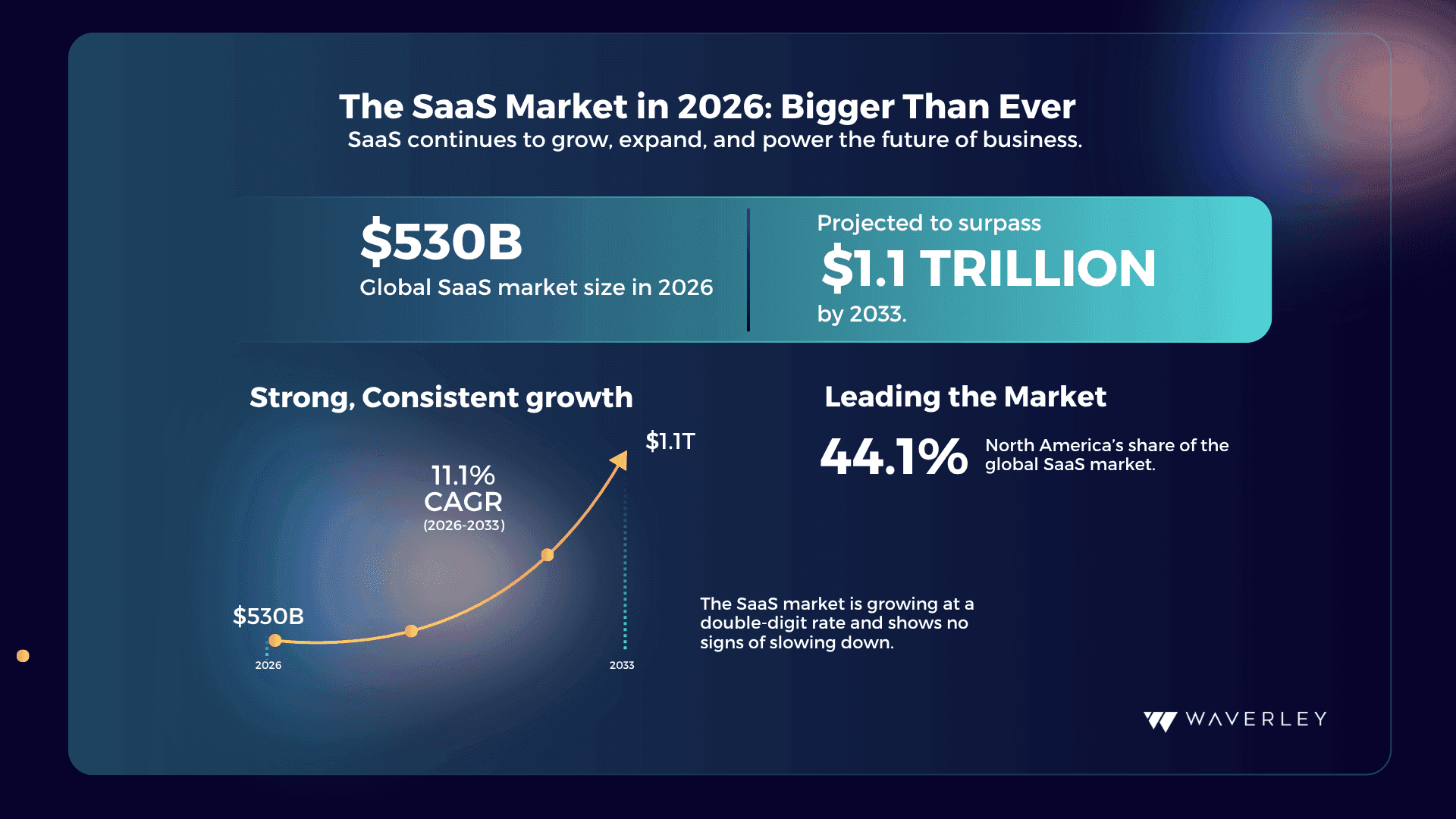
The SaaS Market Is Bigger Than Ever

Enterprises Are Managing More Software Than Ever

But a new problem brought forth by expansion is software sprawl.

Large businesses already oversee an average of 660 SaaS apps and spend around $284 million a year on software subscriptions, according to recent industry figures. The fact that over half of these licenses are still unused is even more alarming.

Organizations are being forced to reconsider their software strategies due to the proliferation of applications. Rather than using more tools, businesses are concentrating more on:

  • Combining suppliers
  • Enhancing system integration
  • Removing unnecessary software
  • Optimizing return on investment from current platforms

SaaS vendors are therefore unable to compete on the basis of features alone. They have to show quantifiable business results.

Artificial Intelligence Has Become a Competitive Requirement

The quick incorporation of AI into SaaS products is arguably the biggest shift since 2024.

What was once thought of as a novel feature is now expected.

Businesses in the sector are integrating AI into almost every facet of their products:

  • Copilots with intelligence
  • Analytical prediction
  • Automated processes
  • Interfaces using natural language
  • Tailored suggestions
  • Capabilities for creating content

Grand View Research claims that ongoing investments in low-code development platforms, workflow automation, and artificial intelligence are emerging as some of the main forces behind SaaS innovation and industry expansion.

SaaS firms now need to focus on how soon they can incorporate AI into their products in meaningful ways rather than whether or not to adopt it.

Agentic AI Is Reshaping the Future of SaaS

Agentic AI is one of the most disruptive developments of 2026.

Users must manually interact with interfaces, dashboards, and workflows in traditional SaaS systems. On the other hand, agentic systems are able to comprehend goals and carry out multi-step activities on their own.

The next generation of enterprise software, according to industry leaders, will depend on networks of AI agents that can function across many systems and applications. Software providers and analysts are already making significant investments in multi-agent systems capable of automating intricate business procedures.

The SaaS business model itself may change dramatically as a result of this transformation.

Software is starting to carry out tasks on behalf of people rather than assisting them.

This change poses completely new queries:

  • How much should software cost?
  • What function will user interfaces serve?
  • If AI agents are capable of carrying out comparable activities, how will vendors set themselves apart?

The next ten years of SaaS innovation will probably be shaped by these questions.

Vertical SaaS Is Becoming More Valuable

Vertical SaaS solutions are being adopted more quickly as a result of the development of AI.

While industry-specific apps continue to gain traction, generic software platforms are under increasing strain.

A growing number of manufacturers, financial institutions, healthcare providers, logistics firms, and educational institutions are looking for solutions that provide:

  • Workflows unique to a given industry
  • Integrated requirements for compliance
  • Domain proficiency
  • Specialized datasets
  • AI models that have been trained on industry-specific data

Access to confidential industry data could be one of SaaS providers' greatest competitive advantages as artificial intelligence develops.

Security and Governance Have Become Strategic Priorities

Concerns around cybersecurity, governance, and data privacy have also grown as a result of the quick development of AI-powered software.

Organizations are looking for answers to questions like:

  • Where is our data being processed?
  • How are AI models using proprietary information?
  • Can confidential data be exposed to third-party models?
  • Who owns AI-generated outputs?

Grand View Research claims that despite the SaaS industry's continuous expansion, growing worries about data security and privacy continue to be one of the main obstacles.

Consequently, software companies are making significant investments in:

  • Private AI deployments
  • Stronger governance frameworks
  • Explainable AI
  • Data residency capabilities
  • Enterprise-grade security measures

Security is no longer just a technical requirement, it has become a key purchasing criterion.

The Future of SaaS Is Outcome-Driven

Scalability, dependability, and user experience are still key components of SaaS development. But in recent years, the industry's interests have drastically changed. The most prosperous SaaS firms in 2026 are developing intelligent platforms that are intended to comprehend customer demands, automate intricate operations, and produce quantifiable commercial results rather than just supplying software via the cloud.

In order to accomplish this, companies are spending more money on AI-native experiences, which incorporate intelligence into their products instead of making it an optional feature. Because they can perform tasks, analyze data, and make recommendations with little assistance from humans, autonomous agents are increasingly becoming an essential component of software ecosystems. At the same time, businesses are focusing more on industry specialization because they understand that having access to sector-specific data and deep domain experience can provide substantial competitive benefits.

The capacity of contemporary SaaS platforms to easily integrate into larger digital ecosystems is another distinguishing feature. Deep connections are a crucial differentiator since businesses want software to connect with other apps, data sources, and automation tools with ease. Additionally, as AI becomes more widespread, data security and governance have shifted from being technical issues to strategic goals, with businesses calling for increased information control, privacy, and transparency.

In the end, intelligent automation and outcome-driven value delivery will play a bigger role in the future of SaaS. Businesses now want platforms that lower complexity, boost productivity, and actively support corporate goals rather than software that only offers functions. Businesses that thrive in this new era will provide intelligence rather than just software, allowing companies to operate more quickly, intelligently, and independently than in the past.

About the author & stay in touch
Michelle Galarza
Michelle Galarza
Content Writer

Michelle is a Bolivia-based communications professional and linguist with a passion for technology, social impact, literature, design, and photography. Through strategic communication and storytelling, she helps bridge the gap between innovation and people, with a particular interest in showcasing Latin American tech talent, highlighting emerging trends in the digital industry, and exploring the impact of technology on businesses and society.

Stay up to date

Subscribe to Waverley's newsletter and stay up to date with the latest articles.

Let's Work Together

Ready to build something great?

Let's talk about your project.

Contact Us