Let's look deeper into the factors that drive market growth.
Increased Usage of Embedded Systems Technology for Healthcare Applications
Embedded systems technology is crucial in developing medical devices that can improve patient outcomes, reduce costs, and increase efficiency, devices providing the processing power, memory, and connectivity needed to support the advanced functionality. For instance, there are numerous devices that monitor vital signs such as blood pressure, heart rate, and oxygen saturation levels. They often rely on embedded systems technology to collect, process, and transmit data and to provide alerts and notifications when abnormal values are detected.
In addition, there is also a growing demand for connected medical devices that can transmit data to healthcare providers in real time. This drives the adoption of IoT-enabled medical devices, which often rely on embedded systems technology to support their connectivity and data processing requirements. Thus, the rising demand for medical devices is expected to drive the embedded systems market.
Increased Demand for Electric and Hybrid Vehicles
In the case of electric and hybrid vehicles, embedded systems are used for various functions such as:
- controlling the electric motor
- managing battery charging and discharging
- monitoring the vehicle's performance
- providing information to the driver.
As the demand for electric and hybrid vehicles continues to grow, the demand for embedded systems that can handle these functions is also increasing. As a result, the embedded system market is expected to grow considerably, largely driven by the increasing demand for electric and hybrid vehicles. This growth is expected to be particularly strong in areas such as automotive electronics, power management systems, and electric vehicle charging infrastructure, which relies heavily on embedded systems technology.
Increased Interest in Sustainable Movements
Energy-efficient solutions, like smart grid management systems, environmentally friendly transportation systems, and green building automation, are being developed with the help of these systems.
This driver encourages using these systems that support sustainability while satisfying operational and technical needs. It also demonstrates a rising global awareness of environmental challenges.
What About Market Challenges and Opportunities?
The development of embedded systems is relatively high-priced which can restrain the demand for embedded systems in the market. Embedded systems can be complex to design and manufacture, requiring specialized components and production processes. This can result in higher manufacturing costs, making it difficult for some companies to enter, and higher consumer prices. In addition, the cost of developing embedded systems can be significant, particularly for highly specialized applications or industries with strict safety or regulatory requirements. This can be a significant barrier to entry for smaller companies and limit the pace of innovation in the market.
However, as demand for embedded systems grows, manufacturing costs will likely continue to decrease, making these systems more accessible to a broader range of companies and industries.
Talking about market opportunities we need to mention the following factors that are likely to create more opportunities in the near future for the software development embedded market:
- Development of autonomous vehicles
- The rise of IoT app development
- Increasing demand for smart home technology
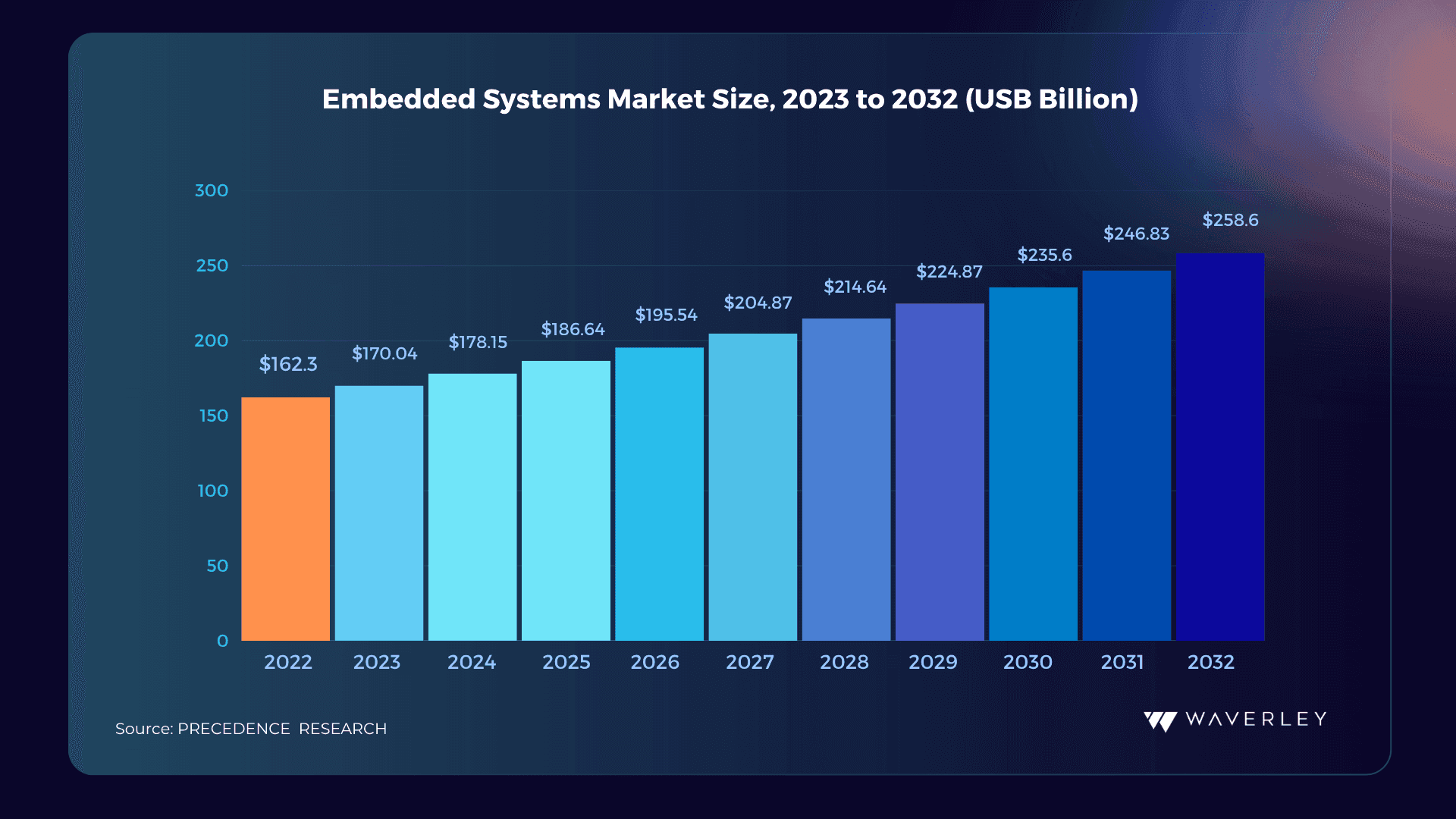
Based on the recent reports, the growing research to develop AI-based embedded systems, specifically AI in Robotics will be one of the future market trends. At present, North America holds the largest share of the embedded market and determines the trends, however, China is anticipated to grow with the highest CAGR in the future.