There’s also a way to program robots by literally teaching them the moves through demonstration by an operator or device called teaching pendants. This is a process reversed to ‘traditional’ programming, where instructions are put down into the system following the robot’s actions and movements.
Another way is called offline programming which is done without connecting to the robot on a computer using CAD systems and simulators. When the system is designed and tested in the virtual environment, it gets deployed to the robot.
Looking Around AI Algorithms
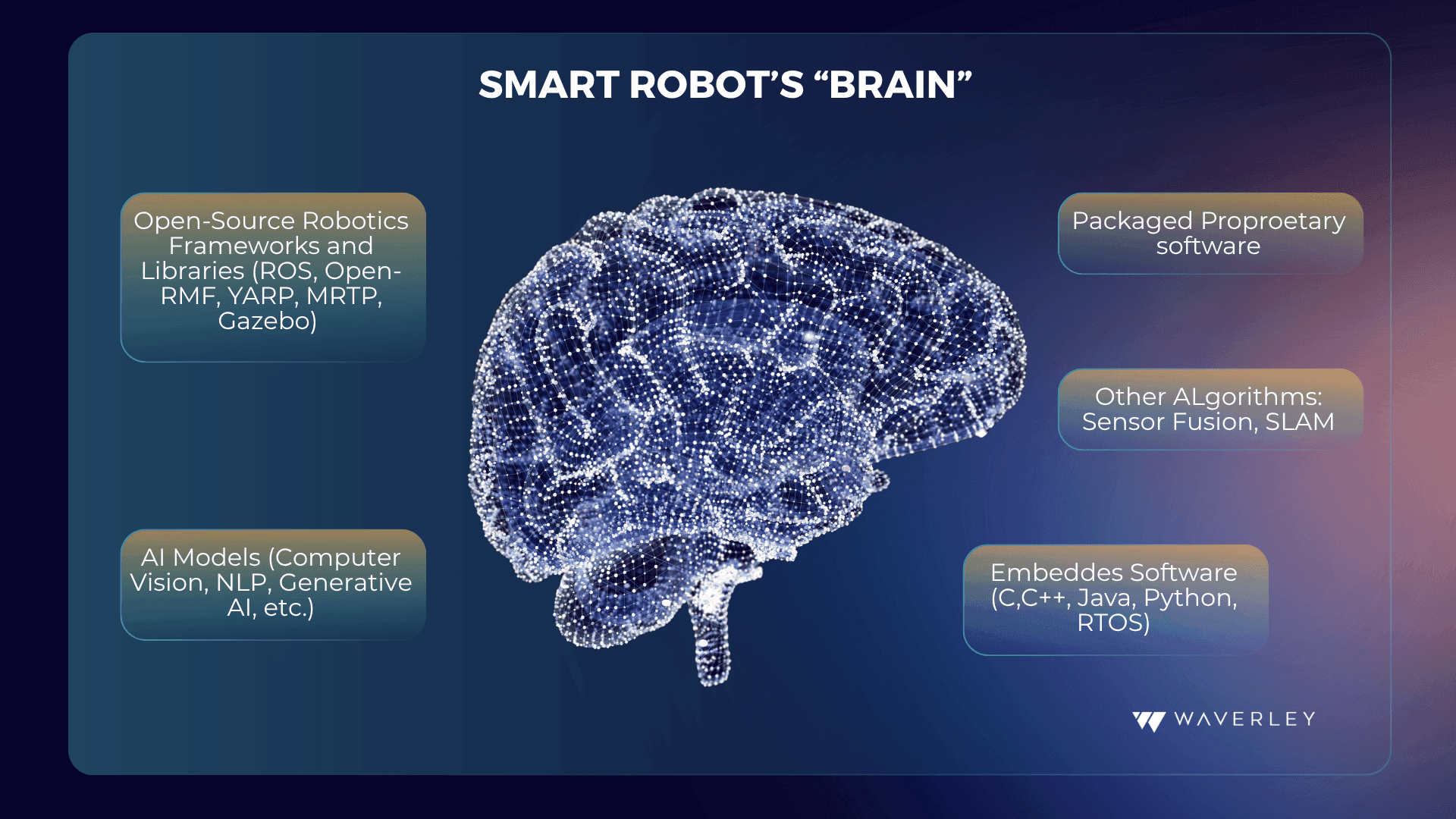
Same as with hardware, your robot’s software depends on the area of application and the purpose of using AI for robotics you have in mind. Some hardware, like the cameras and microphones, come with embedded software. Manufacturers may provide out-of-box development kits, specifically built for AI applications in robotics packed with ready-made ML models, libraries, documentation, and knowledge base, for example, DepthAI or Intel’s RealSense platform.
If you choose to move your computing to the cloud, then you will have the choice from the range of AI technologies and models that solve general ML tasks cloud vendors have to offer. For example, if you want your robot to be able to hold a conversation, you may try using existing services that provide chatbot experience, such as GCP’s Dialogflow or Amazon’s Lex, or deploy your own conversation engines leveraging Meta’s Llama2 in any cloud. You can also create your own ML models and algorithms with Amazon’s no-code solution SageMaker Canvas, Microsoft’s enterprise-grade platform Azure Machine Learning, or GCP’s Vertex AI.
Data Collection and Preparation
This is more of a data science part of the AI robotics development process. When collecting and preparing data for your robot, it is important to take into account the following key aspects:
- The purpose, application area, and functionality of your robot will define the data scope it needs to train on. For example, if it is meant to harvest crops, you will need to train its CV model using the dataset of different crop images to enable the robot to distinguish the fruit from the leaves, the ripe fruit from the unripe one, and so on.
- Data annotation and labeling will be needed for “raw” datasets. There are online resources that offer annotated CV datasets, such as ImageNet or CIFAR-10, but if your application field is too niche or existing datasets are not comprehensive enough, you will most probably have to label your training data yourself using such tools as Doccano, Prodigy, and Label Studio, to name a few.
- Data augmentation. If your robot’s environment lacks data that can be collected naturally, consider data augmentation – the increase of your existing dataset for the system to better handle unseen situations.
- Dataset balancing is business-critical. If certain data categories happen to be underrepresented, you risk making your model biased and erroneous.
- Consider ethical issues. The data you collect and the way you label it will directly impact how your robot might interact with humans – it may turn out to be offensive, discriminative, or reveal some sensitive information.
On Waverley’s blog, you can find an in-depth guide on Data Collection for Machine Learning for actionable insights and strategies.
Testing and Iteration
Similar to regular software testing, robotics systems go through such classic test levels as component, integration, system, and acceptance testing. These help developers make sure robots perform the intended functions and follow the typical use case scenario, meet the projected performance requirements, consume resources adequately and are user-friendly enough.
However, unlike software QA, AI robotics testing includes more than one layer of testing – both software and hardware as well as AI functionality and autonomous work. This should include, for example:
- Simulation and laboratory testing are must-do when developing a robot, especially when access to physical robots is limited or the robot is designed to work in a specific environment.
- Sensor calibration and disturbance testing to make sure all sensors function normally and check how well the robot interacts with its environment.
- Tests for navigation and path planning will verify the robot’s ability to avoid obstacles, create accurate maps, and localize itself.
- Autonomy testing ensures the robot’s decision-making algorithm is robust enough to cater to its adaptability and independent work.
- Human-robot interaction tests evaluate the adequacy and safety of a robot’s perception and response to human speech and behavior.
In addition, it’s always worth mentioning that following best development practices depending on programming languages, processes, and project constraints is the optimal strategy for software development and testing and appliesy equally to AI robotics.
Deployment and Monitoring
Same as testing, application deployment and monitoring are iterative processes, and continuous feedback from real-world usage is essential for refining and optimizing AI robotic systems over time. Regular updates, maintenance, and improvements based on monitoring insights contribute to the long-term success and reliability of the deployed systems.
Consider such aspects of your system important for solution deployment and monitoring:
- Ensure smooth integration of AI models with the Robotic System, paying attention to communication protocols, compatibility with existing hardware, and real-time constraints. Monitoring the system’s adaptability and ability to learn from ongoing experiences, including retraining models based on new data is important here.
- Validate the real-world performance of the AI models, confirming that they generalize well beyond the training data and simulations. Use performance monitoring metrics related to accuracy, response time, and overall system efficiency. Environmental monitoring of conditions that may affect the robotic system’s performance, such as changes in lighting, temperature, or humidity also helps improve the robot’s real-world performance. Predictive maintenance done through monitoring the condition of hardware components and scheduling maintenance or replacements proactively will definitely minimize downtime.
- Implement safety protocols and mechanisms to handle unexpected situations or errors. This includes emergency stop procedures, fail-safes, and monitoring for abnormal behavior. With anomaly detection method, you’ll be able to identify unusual behavior or deviations from expected patterns and address issues promptly. Failure analysis mechanisms, such as logging and recording information about unexpected behaviors, are useful in post-incident analysis.
- Implement measures to protect sensitive data collected or processed by the robotic system. Ensure compliance with privacy regulations and adopt encryption and secure communication protocols. Security monitoring is a good method to detect and respond to potential cybersecurity threats. This is crucial for protecting against unauthorized access or data breaches.
- Ensure your robotic system is compliant with relevant regulations and standards, especially in safety-critical applications. This may involve certification processes and adherence to industry-specific guidelines as well as ongoing monitoring for compliance with relevant standards, regulations, and ethical guidelines.
- Provide training and comprehensive documentation for end-users and operators to facilitate effective deployment and usage to ensure they understand how to interact with and supervise the AI robotic system. User feedback and interaction monitoring will help you understand their experiences with the robotic system. This feedback can be valuable for identifying areas of improvement.
- Implement continuous improvement mechanisms allowing for updates to AI models based on new data and experiences in the field. This includes over-the-air updates for deployed robotic systems and regular system assessment enabling you to timely address any changes in requirements. Resource utilization monitoring, including CPU usage, memory consumption, and power consumption, will be efficient in identifying and addressing any inefficiencies or resource bottlenecks in a timely manner.
Security, privacy, and regulatory issues
As active participants in business-critical, invasive, or potentially harmful operations and processes, AI-powered robots must be restricted by rigorous safety and security legislation, policies, and guidelines. So far, this aspect of advancements in AI and Robotics faces a range of problems to deal with:
- The need for effective privacy protection mechanisms in place.
- Lack of transparency in how data for model training is collected, processed, and used as well as obscurity in AI systems’ decision-making process that may impact human life.
- Lack of coordination and standardization in privacy laws and regulations across countries and regions.
OECD’s Artificial Intelligence Policy Observatory stresses that one of the obstacles hardest to overcome is the considerable gap between the pace of AI technology development and regulatory activity. Regulating tech advancements is about finding the balance between risks and opportunities which is very disputable, especially in the context of global international cooperation.
However, there’s some progress in ensuring data privacy and security on the regional and national levels, pressing software creators to inform users on how their data is used and ask for their consent to do so. Both AI and Robotics industries have to comply with the existing regulations related to data privacy:
- EU’s General Data Protection Regulation (GDPR) provides software users with the right to control how their personal data is collected, processed, and used by different applications.
- The California Consumer Privacy Act enables consumers to have more control over their data that businesses collect and process.
- US states, such as Virginia, Colorado, and Connecticut, actively implement their own legislation on regulating data processing in AI with a 20% pass rate (as compared to the federal-level pass rate of only 2%).
There is also a sector-specific approach to data security regulations:
- The world’s first comprehensive set of rules to govern AI is set to be the EU Artificial Intelligence Act. It is not in force yet, but it has passed the EU provisional agreement and should be implemented in 2025. The AI Act divides its rules on the level of risk an AI system has on society: the higher the risk, the stricter the rules. However, it has been heavily debated by the EU members as potentially discouraging the EU market for AI-focused businesses.
- As for robotics, in the EU it is regulated by the Machinery Regulation law, ensuring machines’ safety and increasing users’ trust in technology, reducing administrative burden and costs for manufacturing, setting up clear legal rules for manufacturing, and establishing safeguards against non-compliant machinery products.
- In the US, the Health Insurance Portability and Accountability Act (HIPAA) sets the standards for the protection of patient health information which is relevant for AI Robotics applications in the Healthcare domain.
- California’s Senate Bill-327 on The Security of Connected Devices aims to protect user data collected by IoT devices from unauthorized access, destruction, use, modification, or disclosure.
- The US doesn’t have any specific AI regulation so far, except for Biden’s Administration executive order driving the development of AI domain standards and ensuring the responsible and effective use of the technology by government agencies.
- The regulation of robotics in the US is overseen by several federal and industry-specific regulators: the General Industry standard and ISO robotics standards describe the safeguarding rules and other manufacturer requirements, the National Highway Traffic Safety Administration (NHTSA) regulates the automotive robotics applications, and the Federal Aviation Administration (FAA) regulates drone development.
Considering all of the above, it is key to account for your target market’s safety and security requirements for AI and Robotics development, as they may be looser or stricter across regions, countries, and even states.



![[source: https://www.bottobo.com/]](/_next/image?url=%2Fassets%2FRobotics_bottobo2_f212096649.png&w=3840&q=75)
![[source: https://www.ideasparq.com/amr]](/_next/image?url=%2Fassets%2Frobotics_autonomous_floor_scrubber_8a3a9d36f9.png&w=3840&q=75)
![[Source: https://www.solomon-3d.com/accupick-3d/]](/_next/image?url=%2Fassets%2FSolomon_414635aee6.png&w=3840&q=75)
![[source: https://www.kickstarter.com/projects/huenit/huenit-ai-camera-and-modular-robot-arm]](/_next/image?url=%2Fassets%2FRobotics_Huenit_e170545f4e.png&w=3840&q=75)
![[source: https://www.tm-robot.com/en/tm7s/]](/_next/image?url=%2Fassets%2Frobotics_tm_cobot_587626afe8.png&w=3840&q=75)
![[source: https://bostondynamics.com/products/spot/]](/_next/image?url=%2Fassets%2Frobotics_spot_climbs_stairs_7cf3a2e637.png&w=3840&q=75)
![[Source: https://bostondynamics.com/atlas/]](/_next/image?url=%2Fassets%2Frobotics_atlas_runs_balance_a8f8ec9b14.png&w=3840&q=75)