Now, that we’ve discussed the role of Business Intelligence for the Telecom sector, it’s high time we started talking about the actual steps needed for implementing BI solutions in this vertical, including the development and integration of OSS and BSS software. From setting specific goals to interacting with outside partners, the below pointers offer helpful direction for BI projects that succeed.
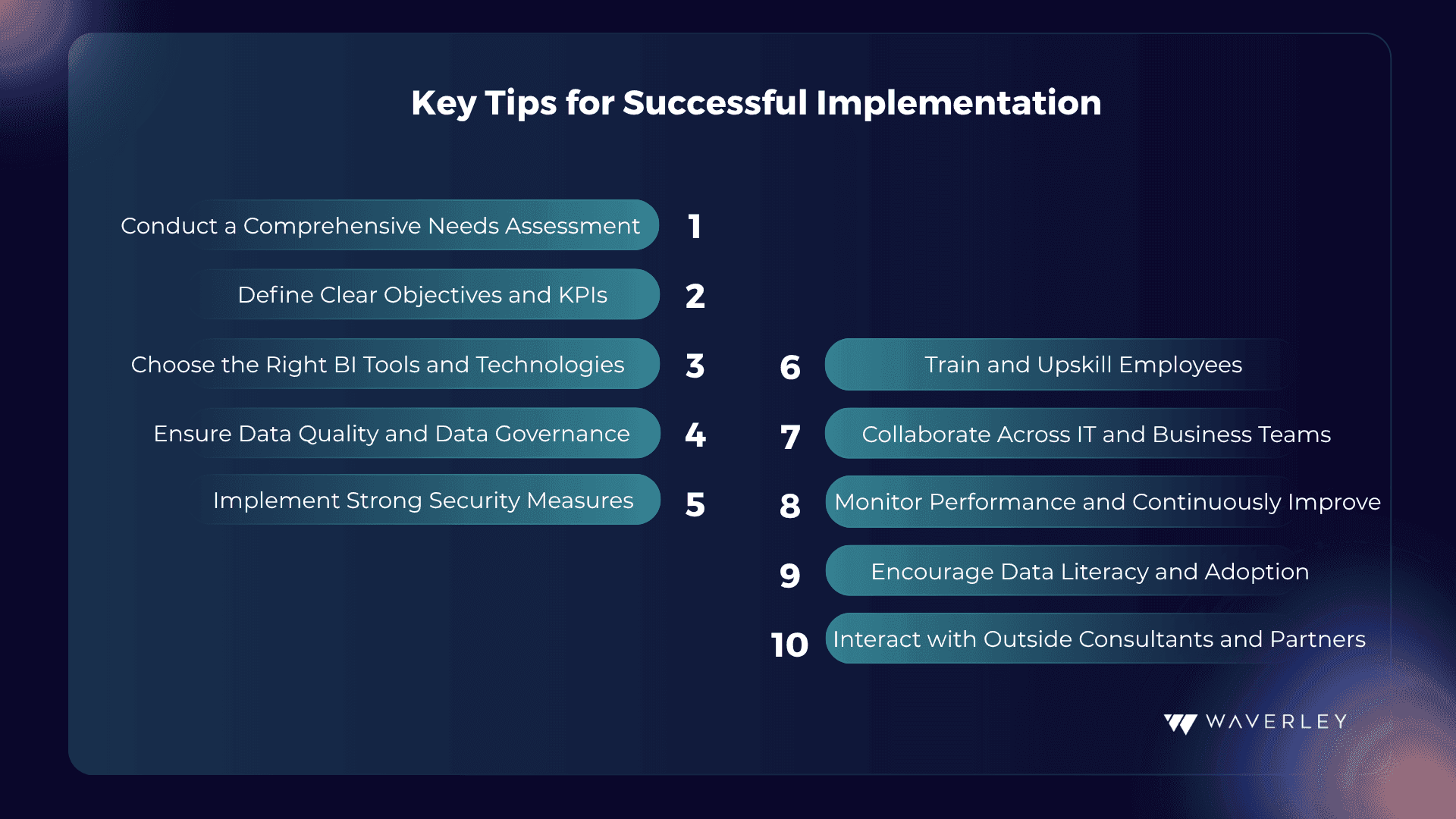
1. Conduct a Comprehensive Needs Assessment
It is critical to start by carrying out a comprehensive analysis of the business needs, obstacles, and possibilities your company has. Determine important stakeholders, get feedback from cross-functional teams, and rank all the revealed aspects according to their viability and business impact.
2. Define Clear Objectives and KPIs
The next step is to clearly define the goals and key performance indicators (KPIs) that align with your business objectives. Set quantifiable goals for the use of business intelligence, such as raising operational effectiveness, decreasing attrition, or enhancing customer happiness.
3. Choose the Right BI Tools and Technologies
Choose BI technologies and tools that will complement your organization’s technological infrastructure, financial constraints, and needs. Such BI instruments may include, for instance:
- Platforms for self-service analytics (such as Tableau and Power BI).
- Tools for data visualization (such as Qlik and Domo).
- Software for predictive analytics (such as SAS and IBM Watson Analytics).
- Cloud-based BI programs (like Google Cloud and AWS).
4. Ensure Data Quality and Data Governance
Make a significant investment in data quality management procedures and set up strong data governance structures to guarantee the precision, coherence, and integrity of your information. Adopt data validation, standardization, and cleansing processes to ensure high-quality and relevant results on the outcome.
5. Implement Strong Security Measures
Take care of data security and privacy by putting strong security measures in place to safeguard sensitive data. To avoid unwanted access or breaches, encrypt data both in transit and at rest, set up user authentication procedures and access controls, and routinely audit and monitor data access.
6. Train and Upskill Employees
Offer thorough training and upskilling initiatives to equip staff members with the abilities needed to utilize BI tools and technologies efficiently. Provide practical training, workshops, and certification courses to develop a workforce that understands data and can use BI insights to make decisions.
7. Collaborate Across IT and Business Teams
To guarantee that technical capabilities and commercial objectives are in line, encourage cooperation and communication between IT and business departments. Encourage strong collaboration amongst cross-functional teams at every stage of the BI implementation process, from gathering requirements to deployment and beyond.
8. Monitor Performance and Continuously Improve
Create performance-tracking systems to measure the return on investment and efficacy of your business intelligence endeavors. Keep an eye on important metrics like report usage, user adoption rates, and KPI accomplishments. Utilize feedback loops to pinpoint areas that require optimization and improvement. To ensure continued success, tweak and adapt your BI strategy frequently in light of new information and lessons discovered.
9. Encourage Data Literacy and Adoption
Encourage data-driven decision making at all levels of your organization to create a culture of data literacy and adoption. By emphasizing the advantages of BI tools and technologies, creating user-friendly interfaces, and providing continuing support and resources, employers can encourage staff members to adopt them. Reward accomplishments and honor individuals or groups that use BI insights to produce favorable results, highlighting the significance of data-driven activities.
10. Interact with Outside Consultants and Partners
Utilize the experience of BI services providers and consultants to enhance internal resources and hasten the deployment of business intelligence. Work together with consultants, specialized suppliers, or industry professionals who have used BI solutions in the telecoms sector. Form strategic alliances to gain access to industry benchmarks, best practices, and state-of-the-art innovations that can improve the efficacy and efficiency of your business intelligence operations. By utilizing outside expertise, telecom firms may maximize the return on investment from their BI projects, reduce implementation risks, and obtain insightful knowledge.