Mindset in the Era of AI Adoption
Artificial intelligence is now in a crucial stage. The future is no longer hypothetical. Large-scale AI integration that directly affects productivity, competitiveness, and strategic decision-making has evolved from what was once restricted to pilots and isolated trials. Today, organizations are less focused on whether they should adopt AI and more on how quickly and responsibly they can do so.
The term “AI adoption” refers to the deliberate integration of automation, generative AI, machine learning, and artificial intelligence into processes, products, and corporate strategy. Global studies, however, repeatedly demonstrate that success is not primarily determined by technology alone. Mentality is the real agent of change.
When combined with an adaptive and learning attitude, a growth mindset enables people and organizations to effectively navigate uncertainty, spur innovation, and fully realize the potential of human-AI partnerships. In the age of intelligent systems, attitude turns into a tactical advantage.
Contents
- Traditional Mindset vs. AI-Oriented Mindset
- Resilience and Adaptability in the Face of Automation
- A Continuous Learning Mindset
- Human-AI Collaboration
- Critical Thinking and Ethics
- Innovation and an Experimental Mindset
- Trust and Fear Management
- Strategic Mindset for Leaders
- Final Thoughts
1. Traditional Mindset vs. AI-Oriented Mindset
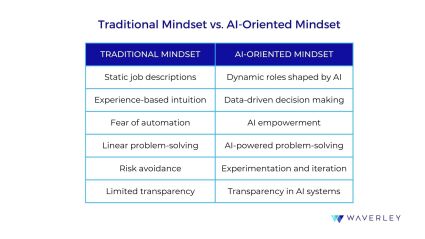
Conventional methods were created for steady conditions. AI-driven ecosystems, on the other hand, necessitate constant adaptability and tolerance for uncertainty. Despite significant expenditures in infrastructure and resources, organizations that do not change their thinking frequently struggle with AI readiness. According to McKinsey, only about 20% of companies report capturing significant value from AI, with cultural resistance and lack of strategic alignment cited as major barriers. An AI-oriented mindset emphasizes flexibility, trust in data, and openness to intelligent automation as a partner rather than a threat.
2. Resilience and Adaptability in the Face of Automation
Automation transforms work by accelerating decision-making speed, procedures, and tasks. Hybrid human-machine professions that require emotional and cognitive flexibility are hallmarks of the workplace of the future.
The World Economic Forum projects that by 2025-2027:
- 44% of workers’ core skills will change
- Demand will increase for skills such as analytical thinking, resilience, and problem-solving
Because of this fact, resilience is a fundamental skill. Organizations and employees who welcome change as a learning opportunity adjust to disruptions more quickly and efficiently. Fear of losing control, significance, or identity is a common reason for resistance to automation. Transparent communication and inclusive AI approaches that put people before performance are necessary to allay this concern.
3. A Continuous Learning Mindset
Compared to conventional training cycles, AI technologies advance more quickly. Consequently, lifelong learning is becoming a necessity rather than a choice.
Strong learning cultures in organizations actively support:
- Upskilling in AI literacy and data fluency
- Reskilling programs for roles affected by automation
- Access to AI-powered tools for personalized learning
LinkedIn’s Workplace Learning Report shows that companies fostering continuous learning are:
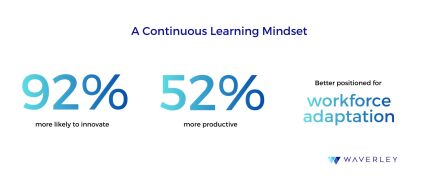
A learning mindset encourages curiosity, experimentation, and comfort with not having all the answers—qualities essential for sustainable AI adoption.
4. Human-AI Collaboration
One of the most important mindset shifts is moving from “AI as replacement” to “AI as collaborator.” Human-AI collaboration combines computational intelligence with human creativity, empathy, and contextual judgment.
Real-world examples include:
- Developers using AI-assisted coding tools to accelerate delivery
- Analysts leveraging machine learning models for deeper insights
- Teams using generative AI for ideation, design, and scenario modeling
It becomes essential to have emotional intelligence in these situations. AI-enhanced teams depend on shared accountability, trust, and communication. When people continue to be in charge of their goals, morals, and ultimate choices, the best results are achieved.
5. Critical Thinking and Ethics
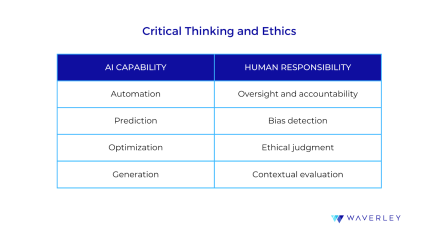
AI systems can amplify both strengths and weaknesses. Without critical thinking, organizations risk over-reliance on automated outputs and hidden biases. This makes AI ethics and responsible AI essential pillars of AI adoption.
Responsible organizations prioritize:
- Explainability and AI trust
- Fairness and bias mitigation
- Clear accountability frameworks
OECD and UNESCO guidelines emphasize human-centric AI, ensuring that technology enhances human well-being rather than undermining it. Positive use cases include AI-driven healthcare diagnostics, while negative cases—such as biased recruitment algorithms—highlight the cost of ethical neglect.
6. Innovation and an Experimental Mindset
AI dramatically reduces the cost and time required to test ideas. With advanced AI-powered tools, teams can prototype, simulate, and iterate faster than ever before.
Organizations that embrace experimentation benefit from:
- Faster product validation
- Data-informed iteration
- Reduced fear of failure
This mindset aligns with tech-driven innovation, where learning cycles are short and insights compound over time. The principle of “fail fast, learn faster” becomes a competitive advantage when supported by AI-enabled experimentation.
7. Trust and Fear Management

Fear remains one of the strongest psychological barriers to AI adoption. PwC reports that while 67% of employees believe AI will change their jobs, fewer than half feel prepared for that change.
Building trust requires:
- Transparent AI systems
- Measurable outcomes
- Clear communication of AI’s role
When organizations invest in transparency and education, AI shifts from a perceived threat to a source of empowerment. Success stories consistently show AI enhancing human judgment, creativity, and strategic thinking rather than replacing it.
8. Strategic Mindset for Leaders
Leadership mindset determines AI outcomes at scale. A strong AI strategy balances innovation, ethics, and long-term value creation.
Effective leaders focus on:
- Organizational AI readiness
- Workforce adaptation and inclusion
- Responsible scaling of AI initiatives
They also foster psychological safety, encouraging teams to experiment, question AI outputs, and learn continuously. Strategic leadership ensures that AI adoption strengthens—not destabilizes—the organization.
Final Thoughts
Adoption of AI is essentially a mindset issue. Change is made possible by technology, but sustained by people. Long-term success is more likely for companies that stress adaptation, foster a growth attitude, and invest in ongoing education.
AI may become a driver for both individual and organizational development by embracing human-AI collaboration, ethical responsibility, and strategic vision.
In order to thrive in an intelligent, automated, and profoundly human future, it is now essential to comprehend how to cultivate a growth mindset for AI adoption.

Build the mindset that drives sustainable AI impact.