The Potential of AI in the Healthcare Industry
Globally, pressure is mounting on healthcare systems. Organizations are being forced to reconsider how care is delivered due to aging populations, worker shortages, increasing volumes of medical data, and rising prices. Given this, artificial intelligence (AI) in healthcare is quickly becoming one of the decade’s most revolutionary technologies.
Electronic health records (EHRs), wearable technology, clinical research, and medical imaging technologies all contribute to the massive volumes of data generated by healthcare institutions today. But a lot of this data is still not being used. Healthcare professionals can now examine these datasets at scale, find trends, and support therapeutic decisions that would be challenging to find using conventional methods, thanks to artificial intelligence.
The market for AI healthcare is growing quickly worldwide. As hospitals and healthtech businesses adopt Healthcare AI solutions to improve outcomes, lower operating costs, and enable more personalized treatment, market research predicts that the sector will grow dramatically over the next 10 years.
At the same time, new opportunities are emerging from developments in machine learning and generative artificial intelligence in the healthcare industry. These include intelligent healthcare platforms, predictive disease identification, and automated clinical documentation.
Contents
- The Current State of Healthcare Technology
- What Artificial Intelligence Means in a Healthcare Context
- Benefits of AI for Healthcare Organizations
- Key Areas Where AI Is Driving Impact
- Generative AI in Healthcare: Emerging Opportunities
- Real-World Use Cases and Industry Examples
- Challenges and Risks in Implementing AI in Healthcare
- How Software Engineering Enables AI in Healthcare
- Best Practices for Successful AI Adoption in Healthcare
- The Future of AI in Healthcare
- How Technology Partners Can Accelerate Healthcare Innovation
- Conclusion: Turning AI Potential into Real Healthcare Outcomes
The Current State of Healthcare Technology
Digitalization is causing a significant technological change in the healthcare industry right now. Numerous businesses are switching from disjointed legacy systems to cutting-edge platforms that enable more advanced analytics and data interoperability.
This change is a component of a larger digital transition in healthcare, as hospitals are implementing advanced analytics tools, cloud infrastructure, and connected medical devices. But even with advancements, many healthcare systems continue to face challenges with:
- Hospital systems’ data silos
- Restricted platform interoperability
- Workflows for manual administration
- Burnout among clinicians is on the rise.
Healthcare companies generate enormous amounts of data every day from imaging, monitoring systems, and patient records, yet a significant portion of this data is not used for decision-making, according to industry reports.
AI healthcare applications are essential in this situation because they can improve clinical and operational efficiency while unlocking value from existing data.
What Artificial Intelligence Means in a Healthcare Context
Artificial intelligence in healthcare refers to a range of technologies designed to analyze complex medical data and support clinical processes.
The most widely used AI technologies include:
- Machine Learning Algorithms: With this technology, systems can forecast outcomes, support diagnosis, and improve therapies by learning from past clinical data.
- Natural Language Processing (NLP): NLP enables AI systems to analyze clinical notes, medical literature, and patient records.
- Computer Vision: Radiology scans, pathology slides, and diagnostic images are all analyzed using this widely used AI technology in medical imaging.
- Generative AI: One of the most recent developments in healthcare, it can generate clinical documentation, medical insights, summaries, and conversational assistants for patients and physicians.
Numerous highly influential AI healthcare applications currently being implemented across healthcare institutions are powered by these technologies.
Benefits of AI for Healthcare Organizations
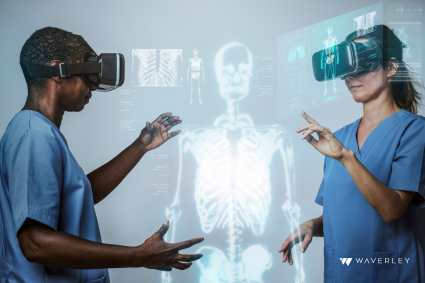
The adoption of AI in healthcare provides multiple strategic benefits.
- Improved diagnostic accuracy
AI models trained on large clinical datasets can identify subtle patterns that may not be visible to clinicians alone.
Research shows that AI diagnostic systems can achieve around 90–95% accuracy in specific medical detection tasks.
- Faster time to treatment
Compared to human workflows, AI-powered imaging systems can interpret images far more quickly, enabling doctors to make choices and start therapy sooner.
AI tools can handle imaging data several times faster than conventional procedures, according to industry reports.
- Enhanced patient experience
Hospitals that integrate AI tools into workflows have reported up to a 48% improvement in clinical efficiency.
- Scalable healthcare delivery
AI enables providers to scale care services in response to rising healthcare demand without increasing staffing levels proportionately.
To address the global shortage of healthcare workers, this competence is essential.
Key Areas Where AI Is Driving Impact
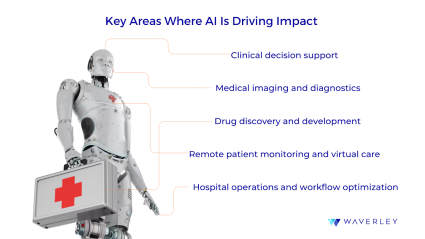
Several domains are leading the adoption of AI in the healthcare industry.
- Clinical decision support
AI systems for clinical decision support examine research data, clinical guidelines, and patient information to help doctors make better treatment choices.
By identifying patterns in large datasets, these techniques help reduce diagnostic errors and improve patient outcomes.
- Medical imaging and diagnostics
Imaging analysis and radiology are among the most sophisticated uses of AI in healthcare.
Research indicates that artificial intelligence models are highly accurate in identifying anomalies such as cancers, fractures, and neurological disorders. Indeed, studies indicate that in some detection tasks.
- Drug discovery and development
AI drug discovery is another innovative field. To accelerate pharmaceutical research, models can analyze biological interactions, molecular structures, and clinical trial data.
AI can cut development cycles by years by drastically reducing the time needed to identify promising drug candidates.
- Hospital operations and workflow optimization
AI-powered patient monitoring is becoming essential in modern healthcare, fueled by the rise of wearable technology and remote care solutions.
AI systems can continuously analyze patient data to identify potential problems before they become serious.
This feature is very helpful for managing chronic illnesses and providing care after hospitalization.
- Remote patient monitoring and virtual care
AI for patient monitoring is becoming a crucial part of contemporary healthcare systems, driven by the growth of wearable technology and remote care platforms.
AI systems can continuously analyze patient data to identify potential problems before they become serious.
This feature is very helpful for managing chronic illnesses and providing care after hospitalization.
And, AI in telemedicine offers new opportunities as telehealth rapidly expands.
- AI-driven systems currently facilitate
- Triage that is automated
- Assistants for virtual health
- Checkers for symptom
- Remote diagnostics
Particularly in underprivileged areas, these solutions increase access to healthcare services.
Generative AI in Healthcare: Emerging Opportunities
AGenerative AI in healthcare is one of the most exciting recent advancements.
Generative AI can generate fresh insights and content from complex medical data, unlike typical AI models that focus on prediction or classification.
Important uses consist of:
- Clinical documentation that is automated
- Medical aides with AI capabilities
- Medical record summarization
- Tools for patient communication
- Research-related synthetic data production
According to market research, as businesses seek new use cases, the generative AI healthcare industry is expected to expand rapidly in the coming years. Additionally, generative AI may help clinicians reduce their administrative workload, a major contributor to physician burnout worldwide. By 2033, the market for generative AI in healthcare is projected to reach USD 23.56 billion.
Real-World Use Cases and Industry Examples
Real-world implementations are demonstrating that machine learning in healthcare can have quantifiable effects across the healthcare ecosystem.
To forecast breast cancer risk years in advance, for example, several hospitals are implementing AI systems that can analyze massive datasets of mammography pictures.
In a similar vein, scientists have developed AI programs that can accurately identify respiratory disorders by analyzing cough sounds captured in smartphone recordings.
These examples show how AI healthcare applications are expanding from research environments into real-world clinical workflows.
Challenges and Risks in Implementing AI in Healthcare
Despite its potential, AI implementation in healthcare also presents challenges.
- Data privacy and security
Due to its high sensitivity, healthcare data must adhere to stringent standards such as GDPR and HIPAA.
AI systems must ensure robust data protection, secure storage, encryption protocols, and full regulatory compliance to safeguard patient information and maintain trust.
- Bias in AI models
AI models trained on small, incomplete, or unbalanced datasets can produce biased results.
Research has shown that some algorithms may unintentionally learn demographic patterns from medical images, potentially leading to disparities in diagnosis or treatment recommendations. Building diverse, continually updated, high-quality datasets and implementing bias-monitoring frameworks are essential to improving fairness and reliability.
- Integration with legacy systems
Since many hospitals still rely on outdated infrastructure, integrating cutting-edge healthcare AI technologies into legacy systems can be complex, costly, and resource-intensive without proper planning, interoperability standards, and experienced engineering support.
- Regulatory Evolution
The regulatory landscape for healthcare AI is rapidly evolving. Governments and regulatory bodies are introducing new frameworks to address safety, accountability, and transparency in AI-driven medical systems. Organizations must continuously monitor changes in AI governance, validation requirements, and risk classification standards to remain compliant and competitive in the market.
- Trust and adoption among clinicians
For AI efforts to deliver real value, clinicians must have faith in the results of AI tools. Validation through clinical trials, explainability of model decisions, and transparency in development processes are critical to driving adoption and ensuring long-term success.
While these challenges are substantial, they are manageable with the right governance structures, cross-functional collaboration, engineering expertise, and change management strategies. Organizations that proactively address these risks will be better positioned to scale AI solutions safely and effectively.
How Software Engineering Enables AI in Healthcare
Successful AI systems require strong engineering foundations to determine operability, security, and reliability.
Implementing AI applications in healthcare involves:
- Robust data architecture and reliable data pipelines
- Scalable cloud infrastructure to support growing workloads
- MLOps practices for deployment, monitoring, and continuous improvement
- Comprehensive security and compliance frameworks
- Seamless interoperability with existing healthcare systems
Engineering teams play a key role in transforming AI prototypes into secure and production-ready healthcare platforms.
Best Practices for Successful AI Adoption in Healthcare
AI has enormous potential in the healthcare industry, but its successful application requires a methodical, planned approach. Because they focus only on the technology, not the environment that supports it, many healthcare companies are unable to fully benefit from AI.
When implementing healthcare AI technologies, healthcare organizations should adhere to the following important best practices.
- Building a strong data foundation
The quality of the data used to train AI systems determines how effective they are. Clinical records, imaging data, lab findings, genomic data, and real-time monitoring streams are just a few of the extremely complex datasets that healthcare organizations handle.
In order for healthcare organizations to implement machine learning effectively, they need to:
- Make sure all systems use the same data.
- Increase platform-to-platform data interoperability
- Put safe data governance models into practices
- Preserve excellent labeled datasets.
One of the biggest obstacles to implementing AI in healthcare systems is data fragmentation. Integrated data architectures that can enable sophisticated analytics and predictive modeling are usually necessary for modern AI endeavors.
Every day, healthcare systems generate enormous amounts of clinical data, but much of it is wasted due to data silos and interoperability issues.
- Cross-functional collaboration (clinicians + engineers + data scientist)
Cross-disciplinary cooperation is one of the most important factors for the successful application of AI in healthcare.
Healthcare AI systems need to align with clinical workflows and medical decision-making procedures, unlike those in other industries. This calls for cooperation between:
- Medical professionals and clinical specialists
- Engineers of software
- Researchers in AI
- Scientists of data
- Regulatory experts
The resulting AI healthcare applications are more precise, practical, and in line with actual clinical needs when these teams collaborate from the very beginning of development.
- Responsible AI governance
AI systems used in healthcare work in highly controlled settings. Governance frameworks must be established by organizations to guarantee safety, equity, and transparency.
Responsible AI tactics ought to consist of:
- Mechanisms for model explainability
- Procedures for detecting and mitigating bias
- Ongoing performance evaluation
- Controls for regulatory compliance
- Protection of data privacy
This is especially crucial for systems that use AI for clinical decision support or medical diagnosis, as inaccurate predictions can directly affect patient outcomes.
The need for varied and representative datasets is underscored by research showing that biased datasets can lead AI systems to produce inconsistent predictions across demographic groups.
- Incremental implementation strategies
Healthcare companies benefit from starting with specific applications where AI can provide quantifiable value rather than trying to implement large-scale changes right away.
Typical places to start are:
- Medical imaging with AI
- Optimization of clinical workflow
- Analytics for predictive healthcare
- Automation of documentation driven by AI
- Systems for remote monitoring
Organizations can expand their AI efforts to other departments and healthcare services after proving their effectiveness in these areas.
The success rate of implementing AI in healthcare initiatives is considerably raised by this stepwise approach.
The Future of AI in Healthcare
The way healthcare is provided will likely change over the next 10 years. AI is advancing smarter, adaptable healthcare ecosystems, surpassing the capabilities of automation and analytics.
The future of artificial intelligence in healthcare is expected to be shaped by several new trends.
- Predictive and preventive medicine
Proactive prevention is replacing reactive treatment in healthcare. The ability of AI systems to evaluate long-term health data and forecast disease risk years before symptoms manifest is growing.
Predictive models can identify patterns related to:
- Risk of cardiovascular disease
- Identification of cancer
- Neurological conditions
- Development of chronic diseases
While improving patient outcomes, early diagnosis can drastically reduce healthcare costs.
Predictive AI is expected to play a major role in healthcare systems worldwide, according to research and industry assessments.
- AI-powered hospitals
Future hospitals will be dependent on integrated AI systems that facilitate almost all clinical and operational tasks.
These systems will come together:
- Healthcare predictive analytics
- Monitoring patients in real time
- Resource allocation and scheduling that makes sense
- AI for clinical decision support
- Workflows for administration that are automated
These solutions have the potential to decrease physician effort and significantly increase hospital efficiency.
According to reports, clinical productivity and operational efficiency have already increased significantly in hospitals that use AI-driven solutions.
- Digital twins in healthcare
The use of digital twins, or virtual representations of patients generated from clinical, genetic, and behavioral data, is among the most cutting-edge new ideas.
Before implementing interventions in real life, these models enable doctors to model treatments and forecast results.
Digital twins have the potential to transform:
- Customized healthcare
- Planning a surgery
- Management of chronic diseases
- Simulations of drug tests
The development of AI healthcare applications has advanced significantly with this invention.
How Technology Partners Can Accelerate Healthcare Innovation
To accelerate the development and deployment of healthcare AI solutions, many healthcare companies partner with specialized technology providers. It takes knowledge of data engineering, machine learning, cloud architecture, and healthcare compliance to implement cutting-edge solutions like intelligent data platforms, scalable AI infrastructure, and predictive analytics in healthcare. Technology partners enable enterprises to create dependable AI healthcare apps that seamlessly integrate with existing clinical systems by bridging the gap between superior engineering capabilities and healthcare experience.These collaborations are particularly beneficial during extensive healthcare digital transformation projects, when companies need to update outdated systems and implement new features like advanced analytics platforms, AI in telemedicine, and AI for patient monitoring. Technology partners can drastically accelerate AI adoption in healthcare, reduce risk, and ensure that AI solutions are scalable, compliant, and aligned with clinical operations by offering expertise in architectural design, secure data pipelines, and model deployment.
Conclusion: Turning AI Potential into Real Healthcare Outcomes
Predictive analytics, sophisticated data platforms, and intelligent technology are propelling the healthcare sector into a new era of transformation.
AI’s range of applications is growing rapidly, spanning medical diagnosis and imaging, drug discovery, patient monitoring, and telemedicine.
However, the ability to deliver quantifiable benefits in patient care is what really makes artificial intelligence in healthcare valuable, not just its innovative capabilities.
Businesses that strategically tackle AI will be successful by:
- Creating robust data ecosystems
- Putting money into scalable AI systems
- Making sure AI is governed responsibly
- Working together between the technological and clinical teams
- Collaborating with seasoned technology suppliers
AI in healthcare will become a fundamental skill rather than a competitive advantage as healthcare systems continue to evolve.
Businesses that make early investments and successfully apply AI will help shape the future of international healthcare delivery.
At Waverley Software, we work closely with healthcare organizations to turn complex ideas into scalable digital solutions. Our team helps providers, startups, and healthtech companies design and build secure platforms—from AI-driven products and data analytics systems to patient-centric applications and integrated healthcare ecosystems. By combining engineering expertise with a deep understanding of healthcare workflows, we support organizations throughout the entire journey, from product strategy and development to long-term platform evolution.

Turn AI potential into healthcare solutions