

AI-Driven BI: From Analytics to Autonomous Decision

Business intelligence (BI) and artificial intelligence (AI) are becoming more than just complementary technologies; they are merging into a single ecosystem that is revolutionizing how businesses function and make decisions.

Modern AI-powered BI enables real-time, predictive, and even prescriptive decision-making, whereas previous BI focused on analyzing historical data to produce insights. Organizations are now shifting away from dashboards and toward intelligent technologies that can automatically analyze data, produce insights, and suggest actions.

BI was still primarily focused on dashboards and reporting in 2024. By 2026, however, BI has evolved into decision intelligence, with AI integrated into business processes and workflows.

Contents

Why AI and BI are Now Inseparable

Extracting value from business data remains quite difficult. But AI is now a corporate requirement rather than a competitive advantage.

AI-powered BI platforms of today can:

  • Do real-time analysis of large datasets
  • Create automated narratives and insights
  • Make recommendations based on forecasts.
  • Make data interactive for non-technical people.

Large language models (LLMs), generative AI, and AI copilots are the main forces behind this change. The primary goal of AI in BI in 2024 was to improve analytics. These days, the focus is on automating intelligence.

How AI is Transforming Business Intelligence

AI is increasing BI’s accessibility, interactivity, and independence. Business users can now interact with data in natural language and obtain immediate insights without relying on technical teams.

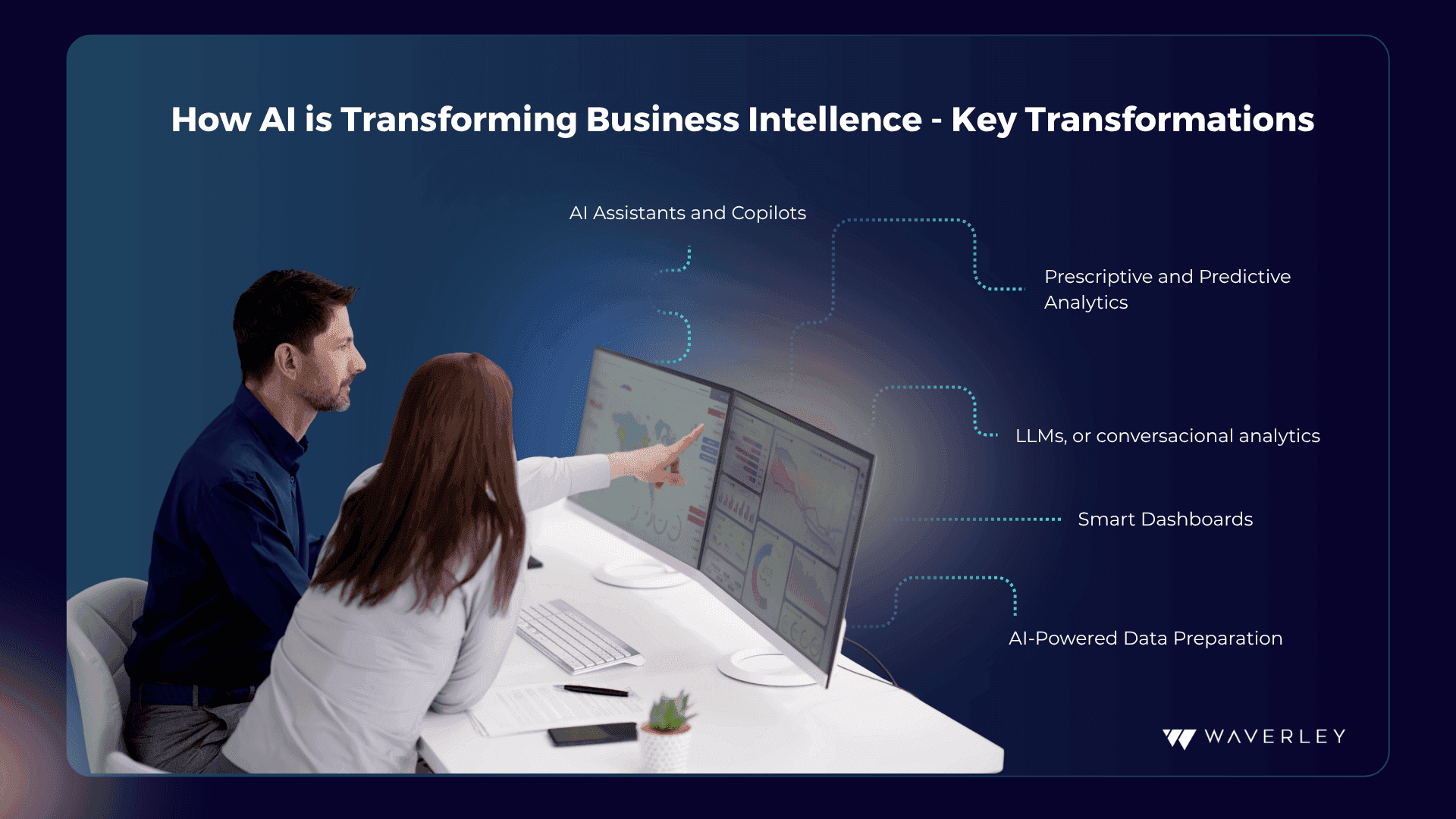
Key Transformations

1. AI-Powered Data Preparation

Data cleansing, normalization, and enrichment are now automated by AI, which uses adaptive learning to continuously improve data quality.

2. LLMs, or conversational analytics

Large language models underpin natural language interfaces that allow users to query data, create reports, and get explanations.

3. Prescriptive and Predictive Analytics

In addition to predicting events, AI also suggests and initiates actions based on those predictions.

4. Smart Dashboards

Dashboards are becoming dynamic systems that eliminate the need for manual analysis by automatically highlighting insights, abnormalities, and recommendations.

5. AI Assistants and Copilots

Within BI platforms, embedded copilots enable users to create reports, pose queries, and automate processes.

Natural language queries were available in 2024. Conversational AI will be the main BI interface in 2026.

Real-World Applications of AI in BI

Prominent companies are using AI-driven BI to make quicker, more intelligent decisions.

1. SAP incorporates AI into its data platforms to facilitate automated decision-making, anomaly detection, and real-time analytics.

2. Domo offers real-time insights and AI-driven dashboards that enable data-driven decisions at scale.

3. Avanade offers generative AI and advanced analytics solutions that are incorporated into business processes.

4. AI copilots built into Microsoft Power BI enable users to create reports and insights using natural language interactions.

These examples show how sophisticated, AI-driven platforms are replacing static analytics solutions.

Key Challenges in AI-Driven BI

Implementing AI in BI presents a number of difficulties despite its potential:

  • Governance and Data Quality

AI systems require well-managed, high-quality data. Inaccurate findings might result from poor data.

  • AI Literacy and the Skills Gap

Organizations need to develop AI literacy throughout all teams, going beyond technical proficiency.

  • Exorbitant Expenses and ROI Uncertainty

Measuring the return on AI investments is a challenge for many businesses.

  • Responsible AI and Regulation

As the use of AI increases, compliance, transparency, and bias prevention become increasingly important.

  • Organizational Opposition

Structural and cultural obstacles may slow the adoption of AI.

Best Practices for Implementation

The selection of appropriate models was the main focus of implementation in 2024. Adoption, usefulness, and business effect will determine success in 2026.

In order to effectively incorporate AI into BI systems, companies ought to:

  • Use AI sensibly, transparently, and under observation
  • Prioritize high-impact use cases with quantifiable return on investment.
  • Assure robust structures for data governance and compliance.
  • Make use of embedded AI technologies and AI copilots
  • Use scalable and cloud-based architectures
  • Develop AI literacy and cross-functional teams

Augmented analytics was regarded as cutting-edge in 2024. By 2026, autonomous and generative intelligence systems will be the main focus. Several major trends are defining the future of BI:

  • Automated report and insight production using generative AI in analytics
  • AI copilots: conversational data interaction
  • Autonomous AI agents are autonomous systems capable of independent analysis and action.
  • Decision intelligence in real time: ongoing, real-time insights
  • Intelligence that is directly incorporated into commercial applications is known as embedded AI.
  • Data democratization: all users have access to insights

The Future: From BI to Decision Intelligence

Business intelligence now focuses on influencing the future rather than merely comprehending the past.

AI allows businesses to:

  • Real-time data interpretation
  • Make very accurate predictions
  • Automate workflows and decisions
  • Scale intelligence throughout the company

Conclusion

Business intelligence driven by AI is now a strategic requirement rather than a choice.

Businesses that successfully incorporate AI into their BI systems can advance from traditional analytics to intelligent operations, automated decision-making, and real-time insights. Businesses that adopt these technologies will gain increased productivity, creativity, and a competitive edge as generative AI, copilots, and autonomous systems develop.

At Waverley Software, we assist businesses in creating and implementing AI-driven BI solutions tailored to their requirements, from strategy to execution, enabling them to turn data into quantifiable business value.

The businesses that use AI-driven BI now will shape tomorrow’s competitive environment.

cta logo

Turn your data into real-time decisions with AI-powered BI